跳到内容
跳到内容 

目录
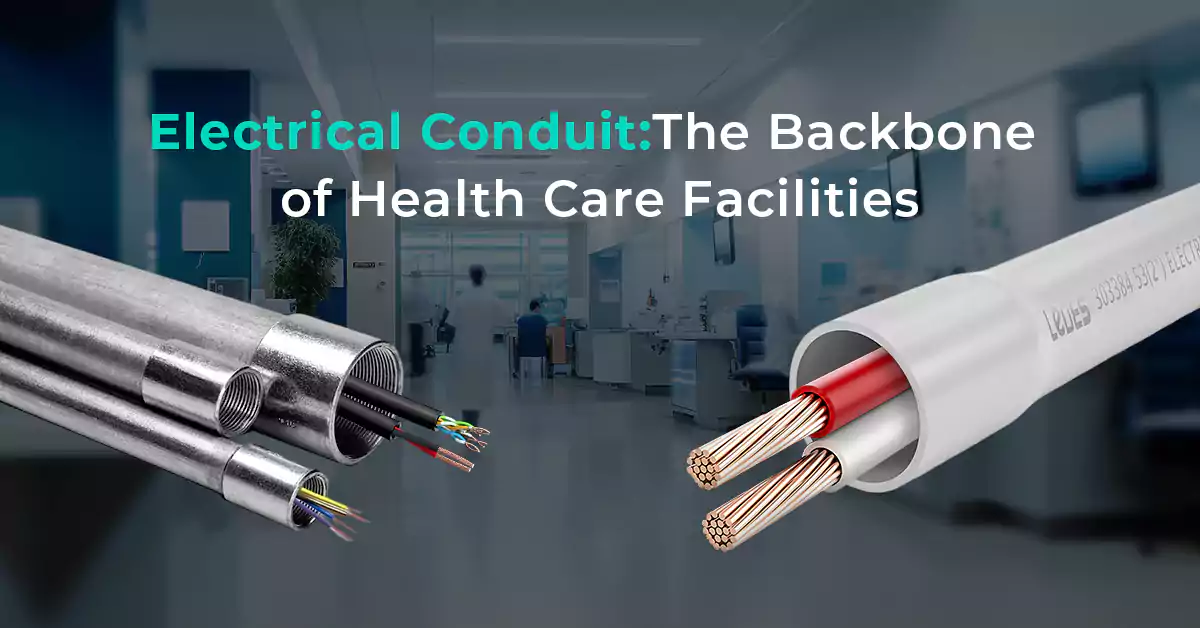
电气导管 plays a fundamental role in the safe and reliable operation of health care facilities. Whether it’s a large hospital, an intermediate care facility, or a community medical center, properly installed conduit ensures that electrical wiring is protected, organized, and compliant with code requirements.
In these environments, the electrical system supports everything from lighting and life-support equipment to data networks and HVAC controls. Electrical conduit, especially types like PVC electrical conduit that helps shield these systems from physical damage, moisture, and interference, while also allowing for efficient installation and maintenance.
This article will explore the importance of electrical conduit in health care settings, common types used, considerations for installation, and how conduit systems support the work of electrical and mechanical engineers, contractors, and facility managers alike.
After reading this article, you’ll know:
- What is electrical conduit and the types for health care facilities
- What is health care facilities and types
- Codes requirements for electrical conduit in health care facilities
- Installation and maintenance of electrical conduit in health care facilities
什么是电气导管?
An electrical conduit is a protective tubing system used to route and safeguard electrical wiring in buildings and structures. It serves two main purposes: mechanical protection of the wires and compliance with safety regulations. Conduits are typically installed in walls, ceilings, floors, or underground to contain insulated conductors, prevent accidental damage, and maintain an organized, code-compliant electrical system.
In health care settings, electrical conduit systems are essential for safely distributing power to critical equipment, emergency lighting, HVAC systems, and mechanical equipment. They also help meet the rigorous code requirements related to fire protection, patient safety, and continuity of service.
A well-designed conduit system in a hospital or clinic ensures the electrical infrastructure remains safe, accessible, and adaptable, which are the factors that especially important in facilities where even minor electrical failures can affect patient care.
7 Common Conduit Types Used in Health Care Facilities
In health care facilities, electrical conduit systems must meet strict safety, hygiene, and reliability standards. Selection is based not just on location and environment, but also on compliance with the National Electrical Code (NEC) Article 517, which governs wiring in patient care areas, critical branches, life safety systems, and essential electrical systems.
Conduit types used are broadly categorized into metallic and non-metallic, and their selection depends on mechanical protection needs, grounding requirements, fire ratings, moisture exposure, and ease of future maintenance.
Metallic Conduit Types
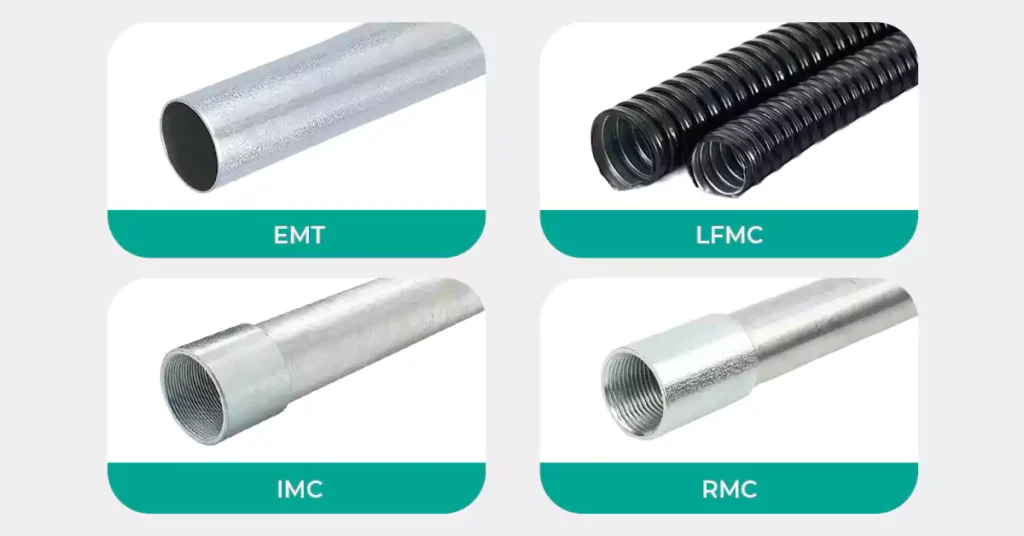
Metallic conduit systems are commonly used in patient care spaces, mechanical rooms, and fire-rated assemblies, primarily due to their grounding continuity, mechanical strength, and fire resistance.
• EMT (Electrical Metallic Tubing)
Widely used in indoor health care applications, including patient rooms, procedure rooms, and general hospital corridors.
EMT is permitted in patient care areas when properly bonded and secured.
优点:
轻便易弯曲
Provides a continuous grounding path
Fire-resistant
限制:
Must be used with listed fittings and bushings
Not recommended for corrosive or wet environments without extra protection
• IMC (Intermediate Metal Conduit)
Applied in areas requiring higher impact resistance than EMT, such as service entrances or exposed mechanical spaces.
优点:
Thicker wall than EMT
Approved for indoor and outdoor installations
Can be used in place of RMC to reduce cost and weight
限制:
Heavier and more rigid than EMT
Requires threading tools if not pre-threaded
• RMC (Rigid Metal Conduit)
Essential in critical areas exposed to mechanical stress or moisture, including generator rooms, rooftop installations, and underground raceways.
RMC is permits in all health care settings; it provides the highest level of physical protection.
优点:
Maximum durability
Excellent for grounding
Corrosion resistance (when galvanized)
限制:
Heavy and more labor-intensive
Requires threading and specialized tools
• LFMC (Liquid-tight Flexible Metal Conduit)
Used to connect vibrating or movable equipment like HVAC units, motors, or pumps in mechanical rooms.
Not generally used as a primary raceway in patient care areas. Limited use permitted where flexibility is essential.
优点:
Waterproof jacket
Flexible routing
限制:
Short runs only
Must be bonded and terminated properly
Non-Metallic Conduit Types
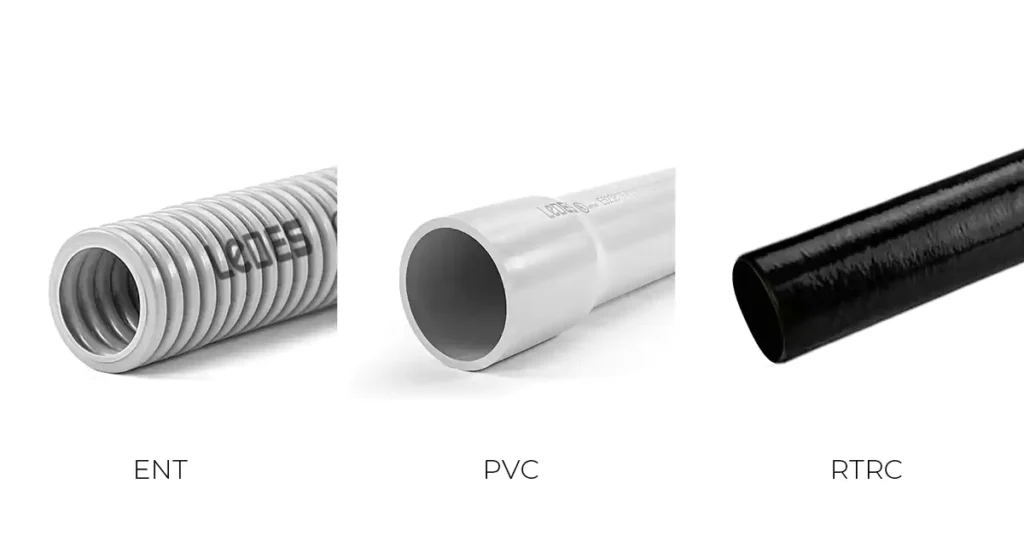
Non-metallic conduits are used more selectively in health care environments, typically in non-patient areas, underground runs, or locations where corrosion is a major concern. Their usage is more restricted inside patient care spaces due to grounding requirements under NEC.
• PVC Conduit (Rigid Nonmetallic Conduit – RNC)
PVC conduit (RNC) commonly used for underground feeder conduits, outdoor lighting, and utility services outside the building envelope.
Not allowed in patient care spaces unless installed in listed metal raceways or systems that provide redundant ground paths.
优点:
Lightweight and corrosion-resistant
Cost-effective
Easy to cut and solvent weld
限制:
Requires proper solvent welding and curing
Not suitable for plenum spaces or critical branch circuits without additional protection
• ENT (Electrical Nonmetallic Tubing)
Used behind walls or ceilings in non-patient care areas, such as administration, offices, or residential quarters.
耳鼻喉科导管 is not permitted in patient care areas per NEC 517.13 due to lack of a continuous grounding path.
优点:
Very flexible and fast to install
Uses snap-lock fittings
限制:
Limited to dry, concealed areas
Cannot be used in fire-rated assemblies unless specifically listed
• RTRC (Reinforced Thermosetting Resin Conduit – Fiberglass)
Rare but valuable in chemical or corrosive environments, such as certain labs or sterilization rooms.
优点:
High corrosion and temperature resistance
非导电
限制:
Higher cost
Requires special adhesive joining and supports
Summary Table:
Here are 7 types of electrical conduit used for Health Care Facilities summary list.
导管类型 | 优点 | 限制 | NEC 参考 | CEC Reference |
紧急医疗救护 | Lightweight, easy to bend; provides continuous grounding; fire-resistant | Not for wet/corrosive areas unless protected; needs listed fittings | Article 358 | Rule 12-1400 to 12-1414 |
整合营销传播 | Thicker wall than EMT; cost-effective vs. RMC; indoor/outdoor use | Heavier than EMT; threading needed | Article 342 | Rule 12-1000 to 12-1014 |
再生材料公司 | Highest durability; corrosion resistant; excellent grounding | Heaviest; labor-intensive; threading required | Article 344 | Rule 12-1000 to 12-1014 |
低频磁共振 | Waterproof; flexible routing | Not for long runs; not primary raceway in patient care; proper termination needed | Article 350 | Rule 12-1300 to 12-1308 |
PVC | Lightweight, corrosion-resistant; easy installation; low cost | Not allowed in patient areas; no inherent grounding; solvent welding needed | Article 352 | Rule 12-1100 to 12-1124 |
耳鼻喉 | Very flexible; fast install; snap-fit fittings | Dry, concealed areas only; no fire rating unless listed; not for patient care | Article 362 | Rule 12-1500 to 12-1514 |
RTRC | High corrosion/temperature resistance; non-conductive | Expensive; special adhesives & supports required | Article 355 | Rule 12-1200 to 12-1220 |
Understanding Health Care Facilities
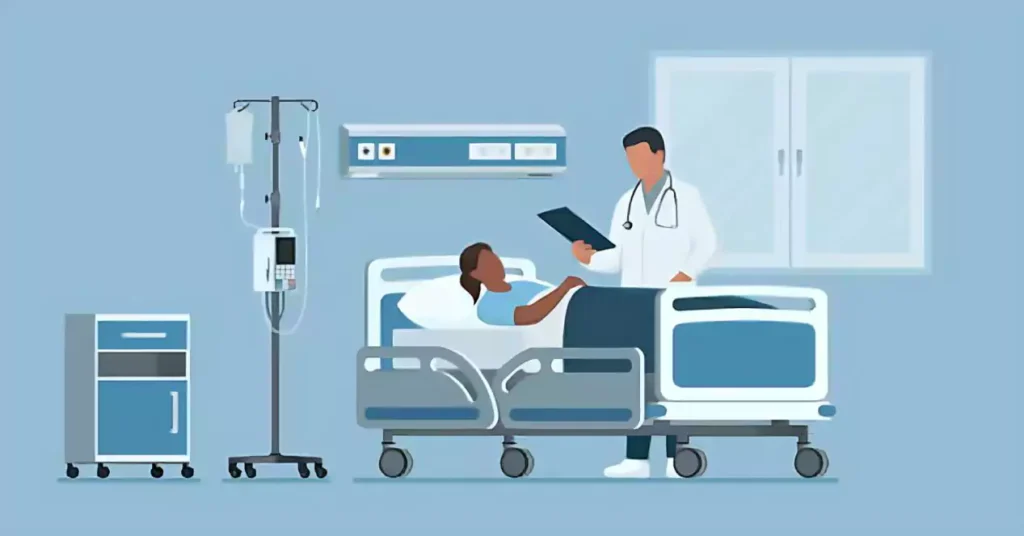
Health care facilities encompass a wide range of building types, each with distinct functions, patient care needs, and infrastructure requirements. Electrical conduit design within these facilities is not one-size-fits-all, it must be tailored to the specific operational and safety needs of the environment.
To support this, the National Electrical Code (NEC) Article 517 – Health Care Facilities provides detailed rules for electrical systems in medical environments, including specifications for wiring methods, grounding, essential systems, and patient protection.
What Is a Health Care Facility?
A health care facility is any building or part of a building where medical, dental, psychiatric, nursing, or surgical care is provided to individuals. This includes treatment areas where patients may be examined, diagnosed, or cared for, whether for routine outpatient visits or for life-sustaining procedures.
NEC defines patient care spaces as areas intended to be used for treatment or care of patients. These spaces require enhanced electrical protection, including strict conduit and grounding rules, to prevent electrical shock, interference, or failure during critical operations.
6 Common Types of Health Care Facilities
Understanding the facility type helps determine conduit system requirements, particularly in patient care zones. Below are the most common categories:
1. Hospitals
Hospitals are large, complex institutions that provide comprehensive medical services, including emergency care, inpatient treatment, surgery, critical care, diagnostics, and specialty care. They operate 24/7 and must support life-saving interventions, continuous patient monitoring, and rapid response capabilities.
Hospitals typically include:
Emergency departments
Intensive care units (ICUs)
Operating theaters
Patient wards
Diagnostic imaging departments
Laboratories
Pharmacy and sterile processing
Mechanical/electrical service areas
2. Ambulatory Health Care Centers
These facilities offer same-day medical services without requiring overnight stays. They are designed to increase access to care while reducing the strain on hospitals.
Common types include:
Urgent care centers
Dialysis clinics
Day surgery centers
Imaging and diagnostic labs
Outpatient therapy and rehabilitation centers
These facilities prioritize patient flow, efficiency, and quick service delivery in a clean, well-controlled environment.
3. Community Health Clinics and Medical Offices
Serving as the front line of preventive care, these facilities are typically located in neighborhoods or rural areas to provide accessible medical services. They focus on routine health checks, vaccinations, chronic disease management, and family medicine.
4. Skilled Nursing Facilities (SNFs)
SNFs offer round-the-clock care for patients recovering from surgery, illness, or injury who require nursing and rehabilitation services. These facilities bridge the gap between hospital discharge and return to home.
5. Assisted Living and Long-Term Care Facilities
These facilities provide housing and limited medical assistance to elderly individuals or those with chronic health conditions who do not require intensive nursing care. Emphasis is placed on safety, mobility, and dignity, with spaces designed to feel more residential.
Common features include:
Private or semi-private rooms
Communal dining and activity areas
Support for medication, hygiene, and mobility
Emergency alert systems in resident rooms
6. Intermediate Care Facilities (ICFs)
ICFs provide long-term care and health-related services to individuals with intellectual or developmental disabilities. These facilities emphasize both medical oversight and support for independent living skills.
Services typically include:
Basic medical monitoring
Behavioral and occupational therapy
Educational and social programming
Residential accommodations
Each of these facility types has specific infrastructure needs shaped by its clinical functions, resident populations, and operational scale. As the article progresses, we will explore how electrical conduit systems are planned and implemented to support these environments safely, efficiently, and in full compliance with applicable standards.
Why Electrical Conduit Matters in Health Care Facilities
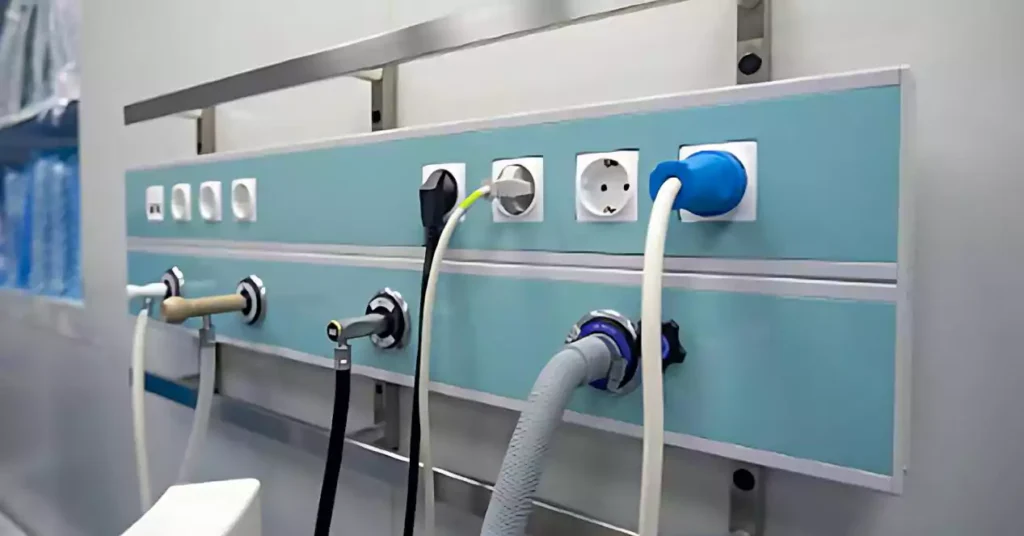
Health care environments demand exceptional electrical reliability. From advanced imaging systems to life-sustaining devices and facility-wide HVAC operations, nearly every aspect of a modern medical center relies on uninterrupted electrical power. In this high-stakes setting, electrical conduit is more than just a protective channel for wires, it is an essential infrastructure component that supports safety, continuity, and adaptability across all departments and systems.
1. Protecting Vital Medical and Support Systems
Modern health care facilities are powered by a wide spectrum of critical equipment:
- Life-support machines and surgical devices
- Imaging and diagnostics systems (e.g., MRI, CT, lab automation)
- Sterilization units and water purification systems
- HVAC systems controlling temperature, pressure, and infection control
These systems operate continuously and must be shielded from mechanical impact, chemical exposure, and environmental stress. Electrical conduit provides this protection, ensuring that cables remain undamaged, dry, and stable under various conditions.
Beyond patient-facing tools, supporting infrastructure like HVAC and water treatment also play a vital role in patient safety. A ventilation failure, for example, could compromise air quality in operating rooms, while an electrical fault in a water system could trigger pressure changes that release biofilms or contaminants.
2. Mitigating Electrical Hazards
Electrical hazards in health care settings are uniquely dangerous due to:
The density of electrical devices
Continuous human occupancy
The vulnerability of patients with limited mobility or awareness
Risks include electrical fires, shock, system malfunctions, and equipment downtime. Conduit mitigates these hazards by:
Physically shielding conductors from damage
Preventing wire exposure in high-traffic or wet environments
Controlling EMI (electromagnetic interference) near sensitive devices
In environments where even a brief outage can result in medical delays or life-threatening interruptions, proper conduit installation becomes a critical first line of defense against electrical failure.
3. Ensuring Operational Resilience
Hospitals and clinics cannot afford downtime. Separate, independent electrical systems are required, such as:
Life safety branch (emergency egress lighting, fire alarms)
Critical branch (patient monitors, ventilators)
Equipment branch (elevators, imaging equipment)
These systems must switch over to emergency power within seconds of a grid outage. Electrical conduit, especially when designed for redundancy and fire resistance, ensures that emergency feeders and backup systems remain intact and functional even under adverse conditions.
4. Adapting to Evolving Medical Technologies
The health care sector is continually evolving. Facilities must be able to accommodate:
New medical equipment (robotic surgery, AI diagnostics)
Infrastructure expansion (new wings, labs, or exam rooms)
Technological upgrades (IoT networks, EV charging for ambulances)
Power demand increases due to digital systems
Conduit systems that are properly planned and enable smooth retrofitting, expansions, and technology rollouts, without needing full system rework. This supports long-term operational flexibility and capital efficiency.
Code Compliance for Electrical Conduit in Medical Centers

In health care environments, electrical conduit systems are not just about protection and routing, they are part of a strict regulatory framework designed to ensure patient safety, system reliability, and facility integrity. Electrical engineers, designers, and contractors must follow national and regional codes that dictate what types of conduit are allowed, how systems must be grounded, and how circuits are to be isolated and protected.
The most relevant standards globally include:
- NEC (NFPA 70, U.S.) – Article 517
- CEC (Canadian Electrical Code) – Section 24
- AS/NZS 3000 / AS/NZS 3003
Below is an overview of these key code requirements:
专业提示: Want to know more about PVC conduit, electrical code compliance expert insights? You can click the link below to read the electrical code compliance in your country.
NEC Code Compliance Tips (NFPA 70, USA)
Canadian Electrical Code Expert Insights (CSA Group, Canada)
National Electrical Code (NEC) – Article 517
The National Electrical Code (NEC), Article 517 is the primary authority governing electrical systems in U.S. health care facilities. It sets detailed installation criteria for hospitals, outpatient clinics, nursing homes, limited care facilities, and other settings that provide medical services to human beings.
Electrical conduit systems play a crucial role in fulfilling NEC’s aims: minimizing shock hazards, ensuring continuity of critical operations, and maintaining system grounding integrity.
Here’s a focused overview of the most important conduit-related provisions:
1. Approved Wiring Methods and Conduit Types
Metallic conduit systems (e.g., EMT, IMC, RMC) are required for branch circuits in patient care areas.
Nonmetallic conduit (e.g., PVC) cannot be used in these spaces unless encased in concrete and paired with an insulated equipment grounding conductor.
Flexible metallic conduit (FMC) may be used in limited cases, such as short connections to movable equipment.
2. Mandatory Redundant Grounding
To reduce voltage differences that can cause electric shock:
- All branch circuits must include an effective ground-fault path via the metal conduit or metallic cable armor that qualifies as an EGC.
- Additionally, an insulated copper equipment grounding conductor (EGC) must be installed with the circuit conductors.
- This dual-path requirement ensures redundant, low-impedance grounding and is mandatory for all receptacles, metal boxes, and fixed equipment in patient care areas.
笔记: PVC conduit alone does not meet the dual grounding requirement and should not be used in patient care spaces unless it meets exception criteria (e.g., concrete-encased runs outside patient areas).
3. Ground-Fault Protection Requirements
Critical care hospitals and facilities with life-support systems must install ground-fault protection on main service and feeder disconnects to reduce arc flash and fire risk.
4. Receptacles at Patient Bed Locations
Minimum receptacles: 8 for general care; 14 for critical care areas per patient bed location.
Must include devices on both normal power and critical branch circuits.
Receptacles must be:
Hospital-grade
Individually grounded via insulated copper EGC
Clearly marked to show panel and circuit origin
5. Essential Electrical System (EES)
Healthcare facilities are required to maintain a multi-branch emergency electrical system, designed to operate during power outages. This is essential for life safety and to prevent disruption to critical operations.
The code requires three separate branches:
Life Safety Branch: Egress lighting, fire alarms, communication.
Critical Branch: Equipment directly supporting patient care (monitors, ventilators).
Equipment Branch: HVAC, imaging, pumps.
Each branch must:
Be powered by separate panelboards and transfer switches.
Use dedicated conduit and raceways, no mixing of circuits.
Be mechanically protected and comply with 517.13 grounding rules in patient spaces.
6. Wet Procedure Locations
Requires shock protection in wet procedure locations (e.g., ORs with washdown), using either:
Isolated power systems or leakage interruption systems.
7. Bonding, Junctions, and Connections
517.13 and 517.19(E) specify approved methods for bonding metal raceways:
- Grounding bushings
- Threaded hubs
- Bonding-type locknuts or bushings
Ensures continuity of the EGC across all junction points.
8. Special Locations (Anesthesia, X-ray, Data, and Fire Alarms)
Article 517 classifies flammable anesthetizing locations as Class I, Division 1 hazardous.
And for Low-voltage systems (e.g., nurse call, fire alarms, signaling) in patient care areas, requiring equivalent insulation and separation but are exempt from full conduit/grounding mandates unless otherwise noted.
NEC Article 517 is one of the most comprehensive and stringent sections of the Code. Its goal is not just to protect systems, but to protect lives – patients, clinicians, and staff, by ensuring electrical integrity in the most sensitive environments. Electrical conduit is at the heart of this strategy, providing both mechanical protection and grounding infrastructure for critical health care circuits.
Canadian Electrical Code (CEC) – Section 24
In Canada, electrical installations in health care settings are regulated by the Canadian Electrical Code (CEC), Section 24: Patient Care Areas. This section outlines specific safety and performance standards for hospitals, clinics, long-term care facilities, and other medical environments where patients may be examined, diagnosed, or treated.
Section 24 imposes special rules beyond general electrical practices, focusing on branch circuit design, grounding and bonding, essential electrical systems, and isolation techniques. These rules aim to reduce the risk of electrical shock, ensure system reliability during emergencies, and protect both patients and healthcare personnel.
1. Designation of Care Areas
CEC Section 24 applies to three types of patient care areas:
- Basic Care Areas (e.g., general treatment rooms)
- Intermediate Care Areas (e.g., intensive monitoring wards)
- Critical Care Areas (e.g., ICUs, operating rooms)
These categories determine the stringency of electrical protection and conduit requirements.
2. 患者护理环境中的分支电路要求
- 所有分支电路必须使用铜导线,线径不得小于 12 AWG。.
- 电路必须源自接地的配电系统,或者在某些情况下(关键/中级护理),源自隔离的电力系统。.
- 为病人护理环境中的插座或设备供电的电路不得为该空间以外的负载供电,相邻房间除外,但须遵守适当的限制。.
- 除非为移动式 X 光机等专用医疗设备供电,否则电路对地电压必须限制在 150 V 以内。.
3. 患者护理区域的接地和连接
必须正确接地,以确保所有可接触的导电表面处于相同的电位,从而最大限度地降低触电危险。.
主要导管和布线要求包括:
- 绝缘连接导体 必须使用,除非用于非金属导管或合适的电缆组件。.
- 每个分支电路 即使在多线配置中,也必须包含专用的设备接地导体。.
- 连接导体 必须与电路导体在同一线槽或电缆内敷设。.
- 配电盘 为这些电路供电时,必须使用符合 CEC 表 16 规定的铜导线进行连接,并且在多个面板之间连接时,导线规格不得小于 6 AWG。.
- 三相设备 医疗/非医疗系统的裸露导电部件必须与单独的导体连接。.
导管系统(金属或非金属)在机械上保护连接路径并保持接地系统和隔离系统之间的适当隔离方面发挥着至关重要的作用。.
4. 插座要求
所有 15 A 和 20 A 非锁定式插座必须是医院级别的(清洁用除外)。.
为便于识别,由重要电气系统供电的插座必须涂成红色。.
任何病人护理区域均不允许使用独立接地插座。.
在用液体清洗或易受洪水侵袭的区域,容器必须:
至少高于地面300毫米,并且
受漏电保护器保护或由隔离系统供电。.
5. 基本电气系统 (EES)
加州能源委员会 (CEC) 规定,医疗机构必须配备必要的电力系统,确保在公用电力中断期间也能持续运行。这可以保障生命安全、关键医疗设备和设施运营不受影响。.
主要组成部分包括:
重要分支: 供应生命维持和病人护理设备。.
延迟重要分支: 支持可在短延迟后重新连接的负载。.
条件分支: 供应其他重要但非生命攸关的货物。.
用于 EES 的导管和线路必须:
与所有非必要系统进行物理隔离。.
应安装在专用线槽、接线盒和机柜中,转换开关或双电源应急灯除外。.
包括自动或手动转换开关,且必须符合 CSA 标准。.
应急电源必须由以下机构提供:
现场发电机组。.
安装在符合消防和机械规范的服务间或封闭空间内。.
6. 关键区域和潮湿区域的独立电力系统
对于某些重症监护或需要进行湿式手术的场所,需要使用隔离式电源系统,以:
限制首次故障期间的对地电流。.
避免电路跳闸,并在保证安全的前提下允许设备持续运行。.
核心要求:
由隔离变压器、电机发电机或电池逆变器供电。.
包括带可视报警功能的线路隔离监视器。.
导体绝缘层必须采用颜色编码(例如,橙色和棕色),并符合特定的介电性能标准。.
为了便于故障识别,每个独立电路只能为单个或相邻房间供电。.
笔记: 接地和隔离电路不能共用同一导管,即使内部是分开的。.
AS/NZS 3000 和 AS/NZS 3003
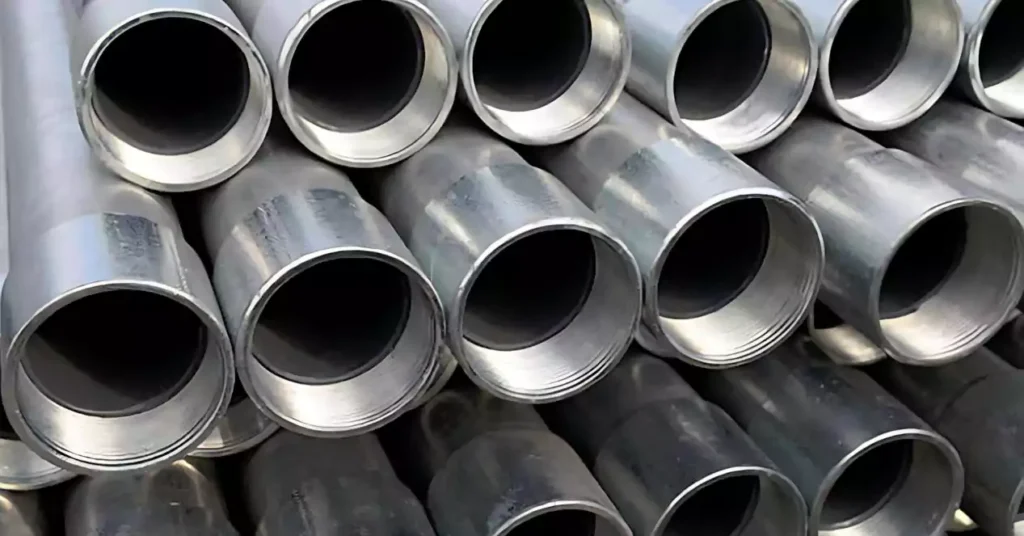
在澳大利亚和新西兰,医疗保健设施的电气装置受两级框架的约束,该框架由 AS/NZS 3000:2018 和 AS/NZS 3003:2018 组成:
- AS/NZS 3000(接线规则) 为所有类型建筑物和场所的安全电气装置制定了一般要求。.
- AS/NZS 3003:电气装置——病人区域 补充这些规则,并对医疗机构患者区域的电气装置作出具体规定,在这些区域,由于患者与医疗电气设备直接接触,安全至关重要。.
AS/NZS 3000:通用布线规则
AS/NZS 3000 是澳大利亚和新西兰所有低压电气装置的基础文件。虽然它并非专门针对医疗保健行业,但它构成了以下方面的法律和技术基础:
- 布线系统和导管类型的选择,
- 安装方法和间隙,,
- 接地、等电位连接和电路保护,
- 服务(权力、控制、通信)的分离,
- 提供防电击、防火、防机械损坏和防欠压保护,以及
- 检验和测试要求。.
AS/NZS 3003:病人区域
AS/NZS 3003 专门适用于“患者区域”,其定义为在诊断、监测或治疗过程中,电气设备可能与患者接触的空间。这包括:
普通内外科病房,
急诊科,
重症监护室(ICU),
手术室,
康复室,
透析和肿瘤治疗区,
心脏导管实验室,以及
提供医疗支持的老年护理房间。.
AS/NZS 3003 区分了两种保护类别:
- 身体保护区域: 在可能与身体发生电接触的地方(例如,普通病房)。.
- 心脏保护区域: 设备可能影响心脏功能或造成危及生命的风险(例如,重症监护室、手术室)。.
AS/NZS 3003规范的关键要求:
布线和配电
禁止环路连接:每个插座都必须连接到专用的最终子电路——禁止串联连接。.
电路必须源自为该病人区域服务的同一配电板。.
电路保护必须避免在病人区域共用零线,以防止触电风险并确保隔离。.
医疗插座需要颜色编码(例如红色或绿色)来表示功能和供电方式。.
插座(电源插口)
只能使用医用级插座。.
由于某些故障情况下触电风险增加,隔离接地(IG)插座在病人区域内不被允许。.
所有插座都必须贴有清晰的标签,并可追溯到供电电路和保护装置。.
等势键合和地球参考
在身体保护区和心脏保护区都需要补充等电位连接。.
接地导体必须将所有裸露的导电部件(如医疗设备外壳、病人床栏杆、金属管道和气体出口)连接到公共接地参考条 (ERB)。.
接地连接对于最大限度地降低接触电压和防止故障或泄漏期间出现危险的电位差至关重要。.
隔离电源系统(IPS)
在心脏保护区域,通常需要隔离电源 (IPS) 来限制故障电流,并在发生单一故障情况时保持供电连续性。.
IPS必须包含:
线路隔离监测器(LIM),用于在发生绝缘故障时向工作人员发出警报;,
通过隔离变压器单独供电,并且
符合 1 类设备使用标准的绝缘监测。.
IPS 电路必须是单相、两线制,并用橙色和棕色导线标识。.
保护装置和剩余电流装置(RCD)
一般用途的插座需要配备剩余电流保护装置 (RCD),但未经医疗机构批准,不得在可能中断生命维持设备电源的地方使用 RCD。.
对于重要电路中的选择性协调和延时RCD,需要特别考虑。.
在某些IPS或隔离医疗系统中,可以省略RCD保护。.
检验和测试
AS/NZS 3003 详细规定了初始验证和定期测试规程,包括:
接地故障回路阻抗,
绝缘电阻,
极性,,
剩余电流动作保护装置(RCD)和限流模块(LIM)的操作,
保护性接地和连接系统的连续性。.
测试必须记录在案,并定期重复进行,以确保持续的安全性和合规性。.
导管和电缆
金属和非金属导管系统必须提供机械保护并满足故障回路阻抗要求。.
不同系统之间必须隔离(例如,电源、数据、护士呼叫和应急照明)。.
根据当地消防法规或医疗保健政策的要求,所有电缆必须为低烟无卤电缆。.
医疗机构电气导管的安装与维护
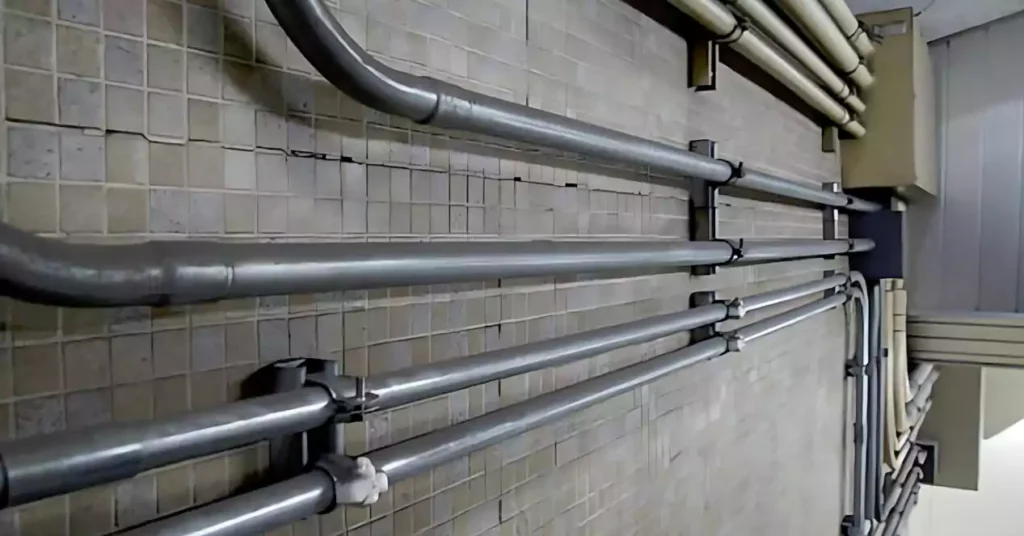
在医疗保健环境中,正确安装和妥善维护电气管道系统是确保电气安全、可靠性和合规性的基础。鉴于患者护理区域存在的特殊风险,例如关键设备负载、生命维持系统以及疏散能力受限等,管道系统的安装必须达到最高标准,并需进行持续维护,以防止故障和停机。.
本节探讨在医院、诊所、疗养院和其他医疗机构中安装和维护导管系统的最佳实践和关键注意事项。.
安装最佳实践
1. 按区域选择材料
医疗机构包含各种类型的空间,每个空间都有特定的电气和环境要求。导管材料的选择应基于以下因素:
患者护理区 (基本、中级、关键):通常需要金属导管(例如 EMT、RMC)进行有效接地。.
核磁共振成像室或影像检查室: 为避免电磁干扰,最好使用非金属导管(例如PVC或玻璃纤维导管)。.
手术室和湿式操作区域: 由于需要增强密封性、耐腐蚀性和机械强度,因此通常使用PVC涂层钢导管。.
2. 种族隔离和赛车场
根据规范要求:
重要系统导管(生命安全、重症监护)必须与非重要线路分开安装。.
避免在不同的电气系统中共用线槽、接线盒或配电盘。.
使用颜色编码的导管或标签来区分正常、关键和应急电源电路。.
3. 接地和连接
接地对于患者安全至关重要,并受到严格监管。导管系统必须:
确保电气系统的持续连通性(尤其是在金属系统中)。.
必要时应安装设备接地导体(EGC),尤其是在病人护理区域。.
遵循特定的连接要求,包括最小导体尺寸和专用连接点。.
4. 密封和感染控制
墙壁和天花板上的导管穿孔应:
使用经批准可用于电气穿孔的防火材料进行正确密封。.
旨在防止手术室或潮湿环境中液体渗入。.
安装方式可最大限度减少灰尘积聚,并有助于保持表面卫生。.
5. 支持和无障碍
所有导管布线必须:
定期进行牢固支撑,防止下垂或移位。.
安装此装置是为了方便检修和更换电缆,以便检修接线点和拉线点。.
布线应避开上方障碍物、医用气体管道或病人床区域(除非有防护措施)。.
维护和检查要求
1. 例行目视检查
设施工程师或电气承包商应进行例行目视检查,理想情况下每半年或每年一次,以检查以下方面:
导管损坏(裂缝、腐蚀、凹痕)
脱落的配件或松动的支架
水或液体渗入箱体或线槽
过时的标记或缺失的标识
2. 接地和连接测试
定期检查粘合完整性至关重要:
测量患者护理空间内设备接地导体与连接点之间的连通性。.
确认金属线槽仍然能够提供有效的故障电流通路。.
检查插座和配电盘的接地情况,尤其是在系统升级之后。.
3. 环境监测
在恶劣环境(例如,暖通空调屋顶、锅炉房、消毒区)中,管道系统必须检查以下方面:
紫外线对塑料导管的降解作用
金属导管系统的腐蚀
振动或冲击造成的机械磨损
4. 升级和改造
当引入新的医疗设备时,导管系统可能需要:
重新布线或加大尺寸以满足载流量和弯曲半径要求。.
重新连接以维持接地故障保护。.
区域重新分类(例如,从普通病房到重症监护病房),需要升级管道以满足更严格的安装标准。.
5. 记录保存和合规性审计
准确的文档记录有助于确保代码合规性和运营连续性:
维护竣工后的导管布置图和电路图。.
记录检查日期、缺陷、维修和测试结果。.
确保设施已做好准备,接受当地电力管理部门或认证机构的合规性审核。.
笔记: 想知道 安装电线导管的详细步骤和专家提示是什么? 您可以点击上面的链接阅读我们上一篇文章。.
结论
在医疗保健环境中,电气可靠性与患者安全密不可分,导管系统远非被动的基础设施,而是生命攸关生态系统的重要组成部分。从支撑关键设备和应急系统,到满足美国(NEC)、加拿大(CEC)以及澳大利亚/新西兰(AS/NZS)的严格规范要求,导管在保护电路、预防危险和增强运行韧性方面发挥着基础性作用。.
总而言之,电气导管在医疗保健领域的作用远不止于隔离。它是安全、性能和可靠性的无声守护者,构成了电气系统的脊梁,尤其是在那些容不得丝毫故障的环境中。.
常见问题解答:
医疗机构中电线导管的主要用途是什么?
电线导管保护线路系统免受物理损坏,为电力、照明、医疗设备和通信等重要服务提供支持,并有助于确保生命攸关系统的不间断运行。它还能实现正确的接地、隔离和防火,这在有脆弱患者和精密电子设备的场所至关重要。.
为什么医疗环境中的电气安全标准如此严格?
患者安全至关重要。在医疗环境中,即使是轻微的电气故障也可能导致人身伤害、设备故障甚至死亡。严格的标准能够最大限度地降低触电、火灾、电磁干扰和系统故障的风险,尤其是在生命维持设备和患者护理区域附近。.
医疗机构通常允许使用哪些类型的电线导管?
允许使用的导管类型包括:
金属线槽(EMT、RMC、IMC)——用于病人护理区域,以确保接地完整性。.
柔性金属导管(FMC)——用于设备连接,但存在一些局限性。.
非金属导管(例如 PVC)——可在病人护理区域外使用,或进行适当的接地和保护。.
医疗机构中常见的电气危害有哪些,坚固的导管有助于缓解这些危害?
患者护理场所发生电击
短路和电弧
过热和电线损坏
生命维持设备断电
敏感设备中的交叉干扰
电缆线路中的火灾蔓延
电气中的 EES 是什么意思?
EES 是“基本电力系统”的缩写,是医疗机构电力基础设施的专用部分,旨在在电力中断期间运行。它确保在紧急情况下患者护理和安全关键系统的连续性。
EES有哪些不同类型?
在医院中,基本电气系统(EES)通常包括:
生命安全部门 – 应急照明、火灾报警器和疏散系统。.
关键分支 – 用于病人生命维持、医疗设备和关键手术的电路。.
装备分部 – 运行所必需的暖通空调、水泵和建筑系统。.
医院的接地系统是什么?
医院采用稳健的等电位接地和连接系统,以维持低阻抗路径并最大限度地减少患者护理区域的电压差。该系统包括:
接地配电系统
设备接地导体
特定区域的孤立地面网络
集中式接地点(例如,患者设备接地端子)
澳大利亚/新西兰的医疗机构是否强制安装剩余电流保护装置(RCD)?
是的,潮湿区域或地面液体可能造成触电危险的地方必须安装剩余电流动作保护装置(RCD)。AS/NZS 3003 标准强制要求在这些高风险场所使用 RCD 保护或隔离式电源系统(配备线路隔离监测器),以防止触电并确保持续运行。.
医疗机构的消防安全要求是什么?
消防措施包括:
用于控制电气火灾的金属导管
医院级防火封堵穿透部位
用于疏散照明和警报的冗余 EES
采用低烟无卤电缆和导管以减少有毒烟雾
医院发生火灾最常见的原因是什么?
电气故障(短路、电弧、过载电路)是医院火灾的主要原因之一,尤其是在高负荷设备和老旧基础设施附近。.
我可以在医疗机构的安装中使用PVC导管吗?
是的,PVC导管可以用于患者护理区域以外的非关键区域,或用于地下线路和馈线敷设。但是,除非配备单独的绝缘接地导体并符合NEC 517的规定,否则不得在患者护理区域内使用PVC导管。.
医院的管道需要接地吗?
当然。患者护理区域的所有导管系统都必须确保设备有效接地。金属导管通常用作接地路径;如果使用非金属导管,则需要单独的绝缘铜接地线。.
医院可以使用软管吗?
是的,但有一些限制。柔性金属导管 (FMC) 或液密柔性金属导管 (LFMC) 可用于设备的最终连接,但必须符合 NEC/CEC/AS/NZS 安装规范,且不得用作患者区域的主要布线方式。.
医院的火灾报警和应急照明是否需要导管?
是的。医疗机构中的火灾报警和应急照明电路被视为生命安全系统,通常必须敷设在金属导管(EMT/RMC)或防火组件中,以确保耐用性、隔离性和符合规范。.