Aller au contenu
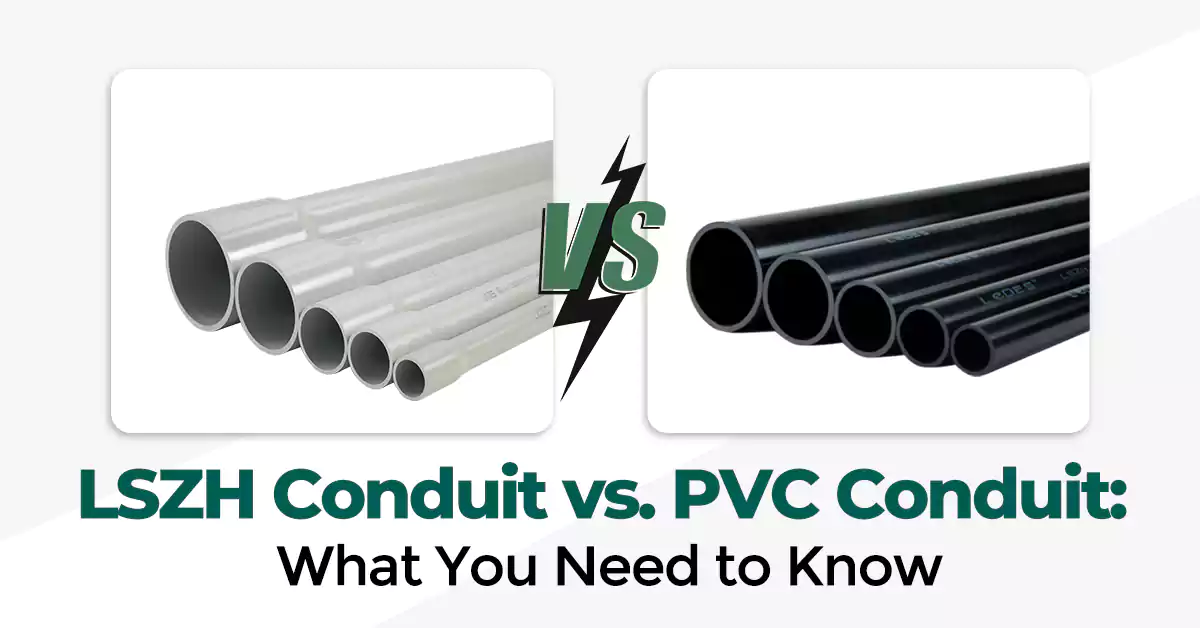
Table des matières
En matière d'installations électriques, le choix du type de conduit approprié est crucial pour garantir la sécurité, la durabilité et la conformité aux normes en vigueur. Parmi les options les plus couramment utilisées figurent les conduits LSZH. Conduit à faible émission de fumée et sans halogène et PVC – conduit en polychlorure de vinyle. Bien que les deux servent à protéger le câblage électrique, leurs propriétés distinctes les rendent adaptés à des applications différentes.
Les conduits LSZH sont conçus pour minimiser le dégagement de gaz toxiques et de fumée en cas d'incendie, ce qui en fait un choix idéal pour les environnements clos ou à haut risque tels que les tunnels, les bâtiments publics et les infrastructures de transport. En revanche, les conduits en PVC sont largement utilisés en raison de leur prix abordable, de leur résistance à la corrosion et de leur facilité d'installation, ce qui en fait une option de choix pour les systèmes électriques résidentiels, commerciaux et industriels.
Le choix des conduits électriques a un impact direct sur la sécurité, la durabilité environnementale et la fiabilité à long terme du système. Des facteurs tels que la résistance au feu, la résistance mécanique, la résistance chimique et la conformité réglementaire doivent être pris en compte lors du choix entre les conduits LSZH et PVC.
Dans cet article, nous allons explorer :
- Principales différences entre les conduits LSZH et les conduits en PVC
- Les avantages et les inconvénients de chaque type
- Leur aptitude à diverses applications
- Respect des normes de sécurité et environnementales
- Considérations pratiques lors du choix du conduit adapté à votre projet
À la fin de ce guide, vous comprendrez clairement quel type de conduit répond le mieux à vos besoins, que vous privilégiiez la sécurité incendie, la rentabilité ou la durabilité.
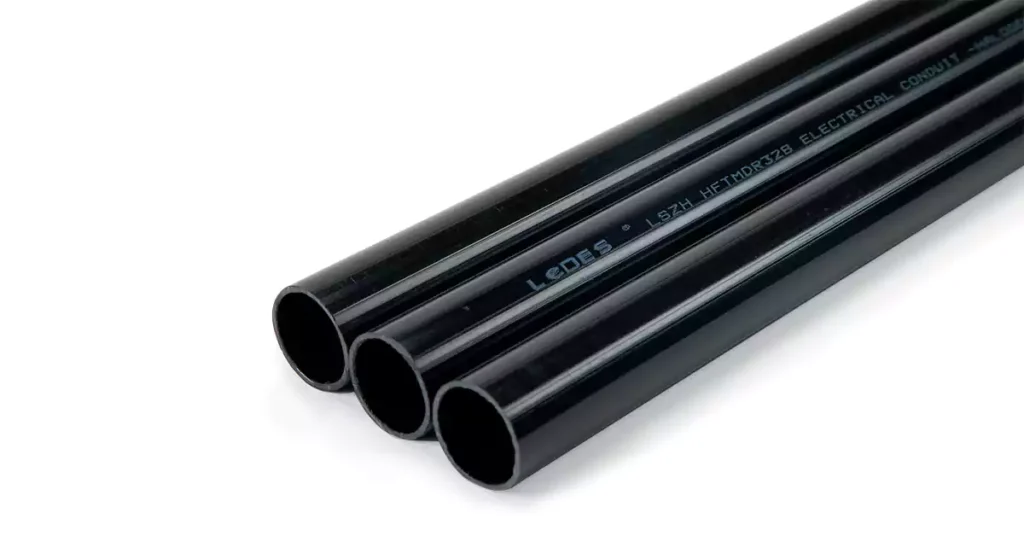
Les conduits à faible émission de fumée et sans halogène (LSZH) sont des conduits électriques en plastique fabriqués à partir de matériaux ne contenant pas d'halogènes tels que le chlore, le fluor, le brome ou l'iode. Contrairement aux conduits en PVC traditionnels, qui peuvent dégager des gaz nocifs en cas de combustion, les conduits LSZH sont conçus pour émettre un minimum de fumée et aucun gaz halogéné toxique en cas d'incendie.
Cela fait des conduits LSZH un choix privilégié pour les applications où la sécurité incendie et la qualité de l'air sont essentielles, comme dans les espaces clos, les bâtiments publics, les tunnels et les centres de données.
Produit nettement moins de fumée que les conduits en PVC traditionnels.
Améliore la visibilité lors d'incendies, facilitant ainsi l'évacuation en toute sécurité.
Réduit les dommages causés par la fumée aux équipements électroniques sensibles.
Sans chlore, fluor, brome ni autres halogènes nocifs.
Prévient la formation de gaz corrosifs et hautement toxiques susceptibles de nuire aux personnes et d'endommager les équipements.
Convient aux espaces clos où le maintien de la qualité de l'air est crucial.
De nombreux conduits LSZH sont conçus pour être auto-extinguibles, empêchant ainsi la propagation des flammes.
Réduit le risque de propagation d'incendie par les systèmes électriques.
Couramment utilisé dans les tunnels, les hôpitaux, les aéroports, les centres de données, les bâtiments commerciaux et les systèmes de transport.
Contribue au respect des réglementations strictes en matière de sécurité incendie et des normes environnementales dans les infrastructures publiques.
Indispensable pour les lieux à forte occupation ou à ventilation limitée.
Les conduits LSZH sont plus respectueux de l'environnement que les conduits en PVC car ils ne libèrent pas de substances dangereuses dans l'air.
Privilégié pour les projets axés sur les certifications de bâtiments écologiques et le développement durable.
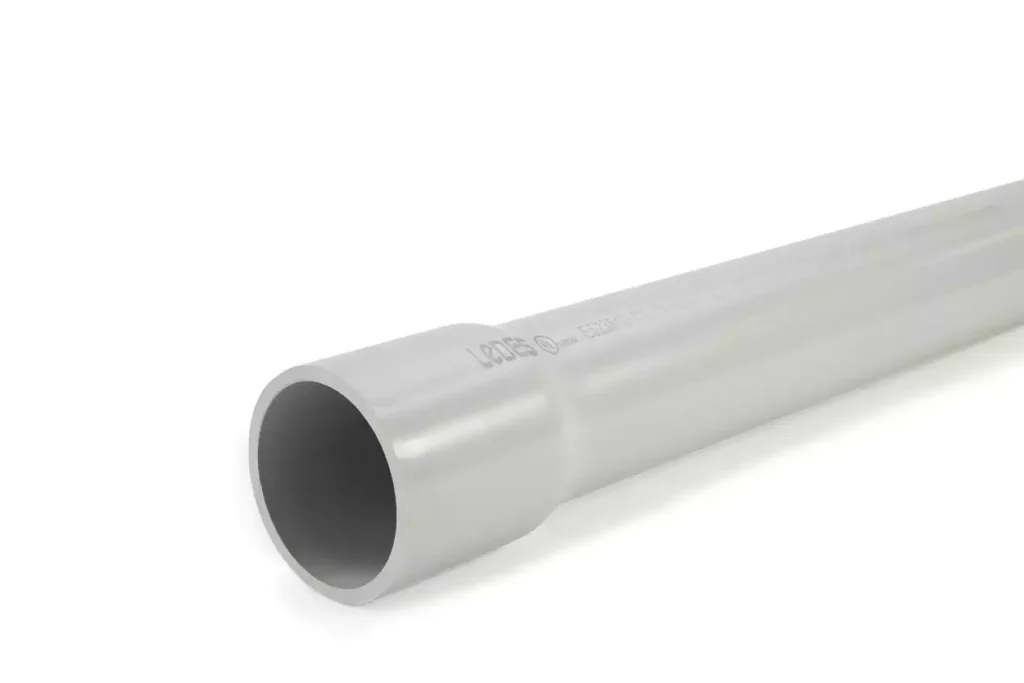
Le conduit en polychlorure de vinyle (PVC) est l'un des types de conduits électriques les plus utilisés, apprécié pour son prix abordable, sa durabilité et sa facilité d'installation. Fabriqué en PVC rigide, ce conduit offre une excellente isolation, une résistance à l'humidité et à la corrosion, ce qui le rend adapté à diverses applications électriques dans les environnements résidentiels, commerciaux et industriels.
Les conduits en PVC sont disponibles en différentes épaisseurs et classifications, telles que les calibres Schedule 40 et Schedule 80, ainsi que des types spécialisés comme le DB2 pour les installations souterraines. Ils sont couramment utilisés pour protéger les câbles électriques contre les dommages mécaniques, les facteurs environnementaux et l'exposition aux produits chimiques.
L'une des options de conduits les plus abordables comparée aux conduits métalliques et LSZH.
Disponible en différentes tailles et types, ce qui facilite son approvisionnement pour diverses applications.
La réduction des coûts des matériaux et de la main-d'œuvre contribue à des installations électriques rentables.
Résistant à la corrosion, à la rouille et à la dégradation chimique, il est idéal pour les environnements humides et corrosifs.
Des options résistantes aux UV sont disponibles pour les installations extérieures exposées au soleil.
Peut résister à diverses conditions environnementales, de l'enfouissement souterrain à l'utilisation en surface.
Léger par rapport aux conduits métalliques, ce qui réduit les coûts de manutention et de main-d'œuvre.
Se coupe, se façonne et s'assemble facilement à l'aide de colle à solvant ou de raccords filetés.
Nécessite un minimum d'outils spécialisés pour l'installation.
Les matériaux non conducteurs éliminent les risques de chocs électriques et de problèmes de mise à la terre.
Des versions résistantes au feu sont disponibles, bien que les conduits en PVC standard puissent émettre des fumées toxiques en cas de combustion.
Utilisé dans les systèmes électriques résidentiels, commerciaux et industriels.
Convient aux installations hors sol et souterraines, y compris l'enfouissement direct et l'enrobage en béton.
Couramment utilisé pour les installations solaires, les télécommunications et les systèmes CVC.
Lorsqu'il s'agit de choisir entre les conduits LSZH (faible émission de fumée et sans halogène) et les conduits en PVC (polychlorure de vinyle), il est essentiel de comprendre leurs différences fondamentales. Ces matériaux diffèrent par leur composition, leur sécurité, leur comportement au feu, leur conformité aux normes, leur installation et leur coût, autant d'éléments qui influencent leur adéquation à diverses applications.
Conseils de pro : Vous pouvez lire notre dernier article pour guide du débutant pour conduits LSZH Tout d'abord, si vous avez des difficultés à comprendre le contenu suivant.
Les conduits LSZH sont fabriqués à partir de composés thermoplastiques ou thermodurcissables spéciaux exempts d'halogènes tels que le chlore, le fluor, le brome ou l'iode. L'objectif principal des matériaux LSZH est de minimiser les émissions toxiques et d'empêcher la formation de gaz corrosifs en cas d'incendie.
Les matériaux LSZH sont conçus à l'aide d'additifs ignifuges alternatifs tels que :
- Hydroxyde d'aluminium (Al(OH)₃) – libère de la vapeur d'eau lorsqu'elle est chauffée, ce qui contribue à étouffer les flammes.
- Hydroxyde de magnésium (Mg(OH)₂) – assure l’absorption de la chaleur et réduit davantage la production de fumée.
- Composés à base de phosphore – améliorer la résistance au feu tout en conservant la flexibilité mécanique.
Ces matériaux ne produisent pas de fumées corrosives lorsqu'ils brûlent, ce qui fait des conduits LSZH un choix plus sûr dans les espaces clos, les nœuds de transport et les infrastructures critiques où la qualité de l'air est une priorité.
Les conduits en PVC sont fabriqués à partir de polychlorure de vinyle, un polymère plastique synthétique contenant du chlore. Bien que le PVC soit naturellement ignifuge grâce à ses propriétés auto-extinguibles, sa combustion libère des gaz halogénés toxiques, comme le chlorure d'hydrogène (HCl).
Ces gaz présentent des risques importants pour la santé, car ils peuvent provoquer de graves irritations respiratoires et contribuer à la corrosion acide lorsqu'ils sont mélangés à l'eau. Ceci est particulièrement préoccupant dans les environnements sensibles tels que les centres de données, les hôpitaux et les tunnels, où la sécurité des équipements et des personnes est primordiale.
- Production de fumée minimale – Améliore la visibilité pour une évacuation en toute sécurité.
- Pas de gaz halogènes toxiques – Réduit les risques pour la santé et prévient les dommages aux équipements électroniques.
- Ne produit pas de gaz acides corrosifs – Prévient les dommages structurels à long terme aux infrastructures.
- Conforme aux normes de sécurité incendie telles que IEC 60754, IEC 61386 et UL 94.
En raison de ces propriétés, les conduits LSZH sont souvent requis dans les zones à haut risque telles que les réseaux de métro, les aéroports, les navires et les installations de télécommunications où les risques d'incendie doivent être minimisés.
- Naturellement ignifuge – Peut s'éteindre de lui-même lorsque la source de chaleur est retirée.
- Dégage une fumée dense et des gaz toxiques – Augmente les risques d’asphyxie et de problèmes de visibilité.
- émissions de chlorure d'hydrogène – Forme de l’acide chlorhydrique au contact de l’humidité, ce qui peut entraîner de graves dommages aux métaux et aux systèmes électriques.
- Conforme aux normes comme les exigences UL 651 et NEC pour une utilisation générale, mais pas idéal pour les applications critiques sensibles au feu.
Bien que les conduits en PVC soient acceptables pour de nombreuses installations électriques, ils peuvent ne pas convenir aux endroits où la sécurité incendie, la qualité de l'air et les risques d'exposition humaine sont des préoccupations majeures.
Le respect des normes industrielles est essentiel pour garantir la sécurité, la durabilité et la performance. Les conduits LSZH et PVC doivent tous deux satisfaire à des exigences réglementaires spécifiques pour être utilisés dans diverses installations électriques.
Les conduits LSZH sont principalement régis par la norme CEI 61386, qui spécifie les exigences de performance mécanique et électrique des systèmes de conduits. La norme CEI 61386-1 sert de référence générale en matière de performance, tandis que la norme CEI 61386-21 concerne spécifiquement les conduits rigides et la norme CEI 61386-23 les conduits ondulés.
Selon la norme IEC 61386, les conduits sont classés en fonction de différents niveaux de performance, indiqués par une série de nombres à deux chiffres dans la norme.
Remarques : Quant à la Norme CEI 61386 pour les conduits électriques, Nous avons déjà publié un article pour expliquer plus en détail ; vous pouvez lire notre dernier article.
La classification prend en compte :
- Par résistance mécanique (par exemple, compression, impact, résistance à la traction, capacité de charge) :
Très léger, Léger, Moyen, Lourd, Très lourd.
- Par flexibilité : Conduit rigide et flexible.
- Selon l'inflammabilité : Sans propagation de flamme et avec propagation de flamme.
Et d'autres facteurs tels que la capacité à résister aux basses et hautes températures, les caractéristiques électriques, l'étanchéité et la résistance à la corrosion, etc.
Exigences de performance :
La norme IEC 61386-1 spécifie une série d'essais mécaniques, électriques et environnementaux que les conduits LSZH doivent réussir afin de garantir leur fiabilité dans les installations électriques. Les principaux essais sont les suivants :
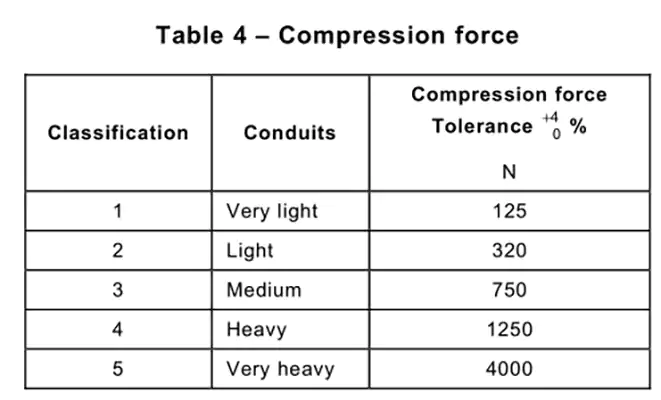
Test de résistance à la compression :
Mesure la force maximale que le conduit peut supporter avant de se déformer ou de céder sous la pression.
Cela implique des forces différentes selon le type de conduit :
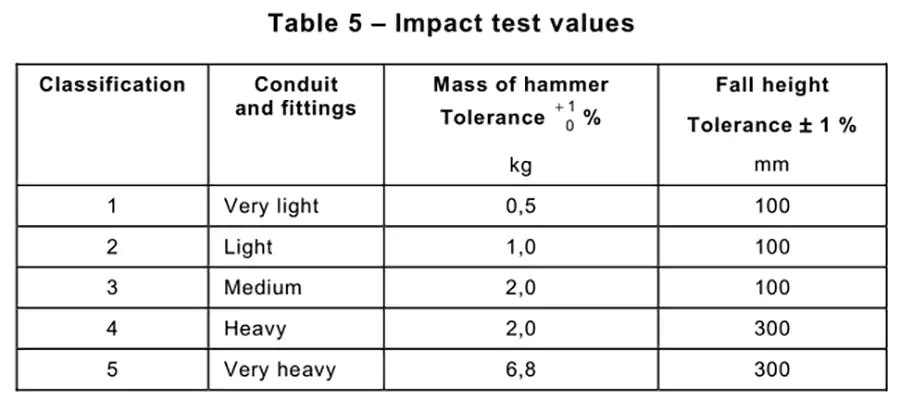
Test de résistance aux chocs :
Évalue la capacité du conduit à absorber les chocs mécaniques, y compris des essais à basse température pour garantir sa résistance aux environnements froids. La masse et la hauteur de l'impact appliqué sont indiquées dans le tableau :
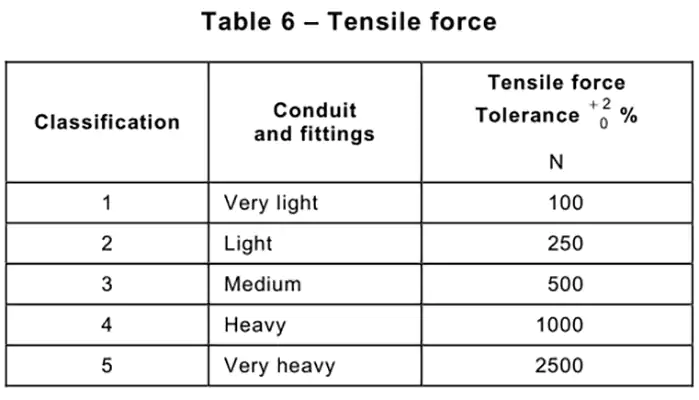
Résistance à la traction:
Cet appareil mesure la résistance du conduit aux forces de traction, garantissant ainsi son intégrité lors du tirage de câbles. Une force de traction est appliquée à une vitesse contrôlée jusqu'à rupture ou allongement excessif du conduit.
Conseils de pro : Nous expliquons détails concernant la résistance aux chocs et la résistance à la traction Dans le dernier article ; vous pouvez le lire si cette partie vous intéresse.
Résistance d'isolation électrique :
Garantit que le conduit offre une résistance électrique élevée afin d'éviter les courts-circuits.
A high voltage (e.g., 1000V to 2000V) is applied between the inner and outer conduit surface.
The conduit must not conduct current or allow leakage.
Fire Performance Test:
Evaluates the conduit’s reaction to fire, do not propagate flames.
Conseils de pro : As to measure fire resistance performance, as we discussed in the last post, you can read it if you are interested in this part.
- Glow-Wire Test (IEC 60695-2-11):
A 750°C glow wire is applied to the conduit in a vertical position.
The conduit passes if there is no visible flame, or if flames self-extinguish within 30 seconds.
- kW Flame Test (IEC 60695-11-2):
A 675 mm conduit sample is mounted vertically and exposed to a 1 kW flame at a 45° angle.
The test ensures that flames self-extinguish within 30 seconds and do not ignite tissue paper placed below.
It involves performance for rigid conduits, including metallic and non-metallic conduits.
Key Test Include:
Compression Test: Refer to the test in the IEC 61386-1.
Essai de flexion :
Determines flexibility and resistance to cracking.
For non-metallic conduits, sizes 16, 20 and 25 and composite conduits are tested to a bending apparatus, and after test, the conduit should show no cracks visible and should be possible to pass the appropriate gauge.
Test d'effondrement :
The collapse test evaluates the mechanical stability of non-metallic and composite conduits, particularly those that are bendable. This test ensures that the conduit maintains its internal passage after exposure to heat, preventing blockages that could interfere with electrical installations.
The conduit is bent according to standard bending requirements without the use of bending aids. And then fixed onto a rigid support using four straps. Exposing the conduit in a heating cabinet for 24 hours.
- After heating, the support is positioned so that the conduit forms a 45° angle to the vertical, with one end pointing upwards and the other downwards.
- A standardized gauge is inserted at the upper end and must pass through the conduit under its own weight without any initial force.
This test ensures that LSZH conduits maintain their internal integrity under high-temperature conditions.
Tensile Test: As described in the IEC 61386-1.
Fire Performance: As described in the IEC 61386-1.
This standard is specially for flexible conduits. Combing with IEC part 1 to set requirements for conduits.
Mechanical Requirements Include:
Compression Test: As described in the IEC 61386-1.
Test de flexion :
The flexing test evaluates the mechanical durability and flexibility of LSZH conduits under repeated bending motions. This test ensures that the conduit and its fittings can withstand mechanical stress during installation and operation without cracking or losing their internal passage.
- The conduit is fixed to an oscillating apparatus that moves it back and forth through a 180° angle around a vertical axis.
- The assembly undergoes 5,000 flexing cycles at a rate of 40 ± 5 flexings per minute in a sinusoidal motion.
- After testing, the conduit must show no visible cracks under normal vision.
- A standard gauge must be able to pass through the conduit under its own weight without additional force.
Tensile Strength, Fire Performance: Refer to IEC 61386-1.
EN 50267-2 is a European standard that specifies the method for determining the acidity and corrosiveness of gases released during the combustion of non-metallic materials, such as LSZH (Low Smoke Zero Halogen) conduits. The standard evaluates whether the materials produce low-acidic and non-corrosive emissions, ensuring their suitability for fire-sensitive applications like data centers, tunnels, and transport systems.
Test Method and Procedure:
General Principle
A predetermined amount of the test material is burned in a tube furnace under controlled conditions. The gases released during combustion are captured and dissolved in distilled or demineralized water, and their acidity (pH) and conductivity are measured.
The water used for gas absorption must have the following properties:
- pH: 6.5 ± 1.0
- Conductivity: ≤ 0.5 µS/mm
These strict requirements ensure the accuracy of the test.
Méthode d'essai
Combustion Process
A 1,000 mg sample of the material is burned in a tube furnace at 935°C under controlled airflow.
The gases released are collected in distilled or demineralized water.
Measurement of Acidity and Conductivity
The pH level of the solution is measured to determine acidity.
The conductivity is measured to assess the corrosive potential of the gas.
Critères de réussite/échec
The material passes if the pH remains above a specified limit (≥4.3) and conductivity stays within the allowed range.
If one sample fails, additional tests are conducted to confirm results.
This test ensures LSZH conduits meet fire safety requirements by minimizing harmful acidic gas emissions, reducing risks to people and equipment.
IEC 60754-1 specifies the method for determining the amount of halogen acid gases released during the combustion of non-metallic materials, such as insulation and sheathing of electrical cables. This test is essential for assessing the potential corrosiveness and toxicity of materials in fire conditions.
Test Method Summary
- Combustion Process
- A test specimen is placed in a quartz glass tube and heated in a tube furnace at 800 ± 10°C under controlled airflow.
- The gases released during combustion are collected in a water solution.
- Halogen Acid Content Determination
- A blank test is conducted first for reference.
- The collected solution is treated with specific reagents and titrated using ammonium thiocyanate to determine the halogen acid content.
- The amount of acid is calculated in mg of hydrochloric acid per gram of test material.
- Evaluation Criteria
If the halogen acid content is ≤ 5 mg/g, the material is considered low in halogen acids, making it safer for use in sensitive environments.
This standard helps ensure materials used in electrical and communication cables produce minimal corrosive and toxic emissions, improving fire safety in buildings, tunnels, and public spaces.
IEC 60754-2 specifies the method for determining the acidity (pH) and conductivity of gases released during the combustion of non-metallic materials used in electrical and optical fiber cables. This test assesses the potential corrosiveness and environmental impact of materials in fire conditions.
Test Procedure Overview
Combustion Process
- The specimen is placed in a quartz glass tube and heated in a tube furnace at 935 ± 30°C under controlled airflow.
- Gases released during combustion are carried by the airflow and collected in a water solution over 30 ± 1 minutes.
Solution Preparation and Measurement
- The collected solution, including any residue from the apparatus, is diluted to 1,000 ml for analysis.
- The pH value is measured using a calibrated pH meter, and conductivity is determined using a conductivity meter, both at 25 ± 1°C.
Evaluation of Results
- The mean pH and conductivity values are calculated from multiple tests.
- If variability is too high (>5%), additional tests are required.
- Weighted pH and conductivity values can be estimated based on the composition of materials in a complete cable.
Performance Criteria
Acceptable pH and conductivity values should comply with individual cable standards or recommended limits in Annex A in the standard.
IEC 61034-2 specifies the method for measuring the smoke density generated when cables burn under controlled conditions. This standard is particularly important for Low Smoke Zero Halogen (LSZH) conduits, ensuring that they emit minimal smoke in case of a fire, thereby improving visibility for evacuation and reducing smoke-related hazards.
The test involves placing the test sample horizontally 150 mm above an alcohol tray, which serves as the fire source. Before ignition, the test enclosure is conditioned to 25°C ± 5°C, and a blank test may be performed. The alcohol is ignited, and the smoke generated is measured by light transmittance over a test duration of up to 40 minutes. The minimum light transmittance is recorded, with a higher percentage indicating better performance.
To comply with IEC 61034-2, LSZH conduits must maintain a minimum light transmittance threshold, typically above 60%, reducing visibility obstruction in fire scenarios. After testing, the combustion products are extracted, ensuring accuracy in subsequent tests.
ASTM E662-17a is a standard test method used to measure the specific optical density of smoke produced by solid materials, such as plastics, cables, and conduits, under controlled fire conditions. This test is important for Low Smoke Zero Halogen (LSZH) conduits, as it assesses their smoke production levels and helps determine their suitability for fire-sensitive environments like tunnels, data centers, and public buildings.
Test Method Summary
- Test Chamber and Sample Placement
The test is conducted in a closed chamber (smoke density chamber) with a light beam and photodetector to measure smoke density.
A sample of the test material is placed on a holder inside the chamber.
- Combustion Process
The sample is exposed to a heat source in either:
Flaming Mode: Direct exposure to a flame.
Non-Flaming Mode: Exposure to radiant heat without direct ignition.
- Smoke Density Measurement
The specific optical density (Ds) is calculated based on how much light is blocked by smoke inside the chamber.
The maximum specific optical density (Ds max) is recorded.
- Performance Criteria
Materials with lower Ds max values are considered better in terms of low smoke emission.
LSZH materials must have a Ds max within acceptable limits to be used in safety-critical applications.
ASTM E662-17a ensures that LSZH conduits produce minimal smoke, improving fire safety and visibility in emergency situations. It is widely used alongside IEC 61034-2 for evaluating the smoke performance of electrical materials.
ISO 4589-2 specifies a method for determining the minimum concentration of oxygen required to support the combustion of plastic materials under ambient temperature conditions. This is known as the Limiting Oxygen Index (LOI) and is expressed as a percentage. The higher the LOI, the greater the material’s resistance to burning in normal atmospheric conditions.
This test is essential for evaluating the fire resistance of LSZH conduits and other plastic materials used in electrical and construction applications. Materials with a higher LOI are more flame-retardant and offer improved fire safety performance.
ISO 19700 defines a standardized method for assessing the hazardous components of fire effluents. It focuses on measuring the toxic gases released during material combustion under controlled fire conditions. The method helps evaluate the potential risks of materials used in various applications, including electrical conduits, ensuring fire safety compliance.
Test Method Summary
Appareil de test : A steady-state tube furnace is used to simulate different fire conditions by varying the equivalence ratio (the ratio of fuel to available oxygen).
Procédure de test :
- The test material is placed in the tube furnace, where it undergoes controlled burning.
- The fire conditions range from well-ventilated to under-ventilated, replicating real-life fire scenarios.
- The combustion gases are collected and analyzed for toxic components such as carbon monoxide (CO), carbon dioxide (CO₂), hydrogen cyanide (HCN), hydrogen chloride (HCl), and other hazardous species.
Results Evaluation: The measured gas concentrations help determine fire toxicity, allowing material classification based on its fire hazard potential.
ISO 19700 is essential for evaluating low-smoke, halogen-free (LSZH) materials, ensuring they release minimal toxic gases in case of fire, making them safer for enclosed environments like buildings and transportation systems.
La norme UL 94 est une norme d'inflammabilité largement reconnue qui évalue le comportement au feu des matériaux plastiques utilisés dans les applications électriques et électroniques. Cette norme est essentielle pour évaluer la performance en matière de sécurité incendie des conduits LSZH (Low Smoke Zero Halogen), garantissant ainsi leur conformité aux exigences strictes de résistance au feu tout en minimisant les émissions toxiques en cas d'incendie.
But
L'objectif principal de la norme UL 94 est de classer les plastiques en fonction de leur comportement au feu, offrant ainsi des informations sur leur adéquation à diverses applications où la résistance au feu est essentielle.
Évaluations et exigences
La norme L 94 classe les matières plastiques en plusieurs catégories, chacune ayant des critères spécifiques :
- HB (Combustion horizontale) :
Méthode d'essai : Un échantillon est positionné horizontalement et exposé à une flamme pendant 30 secondes ou jusqu'à ce que la flamme atteigne un repère spécifié. La vitesse de combustion est ensuite mesurée.
Critères: Pour les matériaux d'une épaisseur de 3 à 13 mm, la vitesse de combustion ne doit pas dépasser 40 mm par minute ; pour ceux d'une épaisseur inférieure à 3 mm, elle ne doit pas dépasser 75 mm par minute.
Notation: HB indique une combustion lente sur un échantillon horizontal.
- Combustion verticale (V-0, V-1, V-2) :
Méthode d'essai : Un échantillon orienté verticalement est soumis à deux applications de flamme de 10 secondes. Après chaque application, les durées de post-flamme et de rémanence sont enregistrées, ainsi que l'observation des particules qui s'écoulent.
Critères:
V-0 : La flamme s'éteint en moins de 10 secondes ; aucune goutte enflammée n'est tolérée.
V-1 : La flamme s'éteint en 30 secondes ; aucune goutte enflammée n'est tolérée.
V-2 : La flamme s'éteint en 30 secondes ; les gouttes enflammées sont tolérées.
- Test de combustion verticale, test sévère :
Méthode d'essai : Les échantillons sont soumis à cinq applications de flamme de 5 secondes avec une source d'inflammation plus puissante.
Critères:
5VA : La flamme s'éteint en moins de 60 secondes ; aucune perforation (pas de trou) dans l'échantillon.
5VB : La flamme s'éteint en moins de 60 secondes ; la perforation (trou) est autorisée.
Ces classifications aident les fabricants à choisir les matériaux plastiques appropriés afin de garantir la conformité aux normes de sécurité et aux exigences réglementaires.
Notation | Orientation | Application de flamme | Exigences | Les gouttes sont-elles autorisées ? | Autorisation de combustion complète ? |
HB | Horizontal | Vitesse de combustion inférieure à 76 mm/min pour un échantillon de moins de 3 mm d'épaisseur et arrêt de la combustion avant 100 mm. | |||
V-2 | Verticale | 30 secondes | La combustion s'arrête en 30 secondes ; les gouttes enflammées sont autorisées. | Oui | Non |
V-1 | Verticale | 30 secondes | La combustion s'arrête en 30 secondes ; les gouttes de particules sont tolérées tant qu'elles ne s'enflamment pas. | Non | Non |
V-0 | Verticale | 10 secondes | La combustion s'arrête en moins de 10 secondes ; les gouttes de particules sont tolérées tant qu'elles ne s'enflamment pas. | Non | Non |
5VB | Verticale | 60 secondes | La combustion s'arrête en 60 secondes ; pas de gouttes enflammées ; les trous sont autorisés | Non | Oui |
5 VA | Verticale | 60 secondes | La combustion s'arrête en moins de 60 secondes ; aucune goutte enflammée ; aucun trou. | Non | Non |
Ledes' Conduits LSZH sont conçus en mettant l'accent sur une sécurité incendie supérieure. Certifiés UL 94 V-0 et 5VA, ils garantissent :
Évaluation V-0 : Extinction automatique rapide en moins de 10 secondes sans coulures enflammées, adaptée aux applications exigeant une haute résistance à la flamme.
Puissance nominale 5VA : Performances exceptionnelles dans des conditions de flammes extrêmes, sans perforation, ce qui les rend idéales pour les applications de sécurité critiques.
Ces caractéristiques font des conduits Ledes LSZH un choix fiable pour les environnements où la sécurité incendie et la réduction des émissions de fumée sont primordiales.
La norme UL 1685 a été élaborée pour évaluer la propagation des flammes et le dégagement de fumée des câbles électriques et à fibres optiques exposés au feu. Cette norme comprend deux méthodes d'essai principales : Test d'exposition à la flamme UL et le FT4/IEEE 1202 Type d'essai d'exposition à la flamme.
▲ Test d'exposition à la flamme
Le test d'exposition aux flammes UL 1685 évalue la résistance au feu des câbles électriques en analysant la propagation des flammes et la production de fumée.
Configuration de test
Un brûleur à gaz propane avec une plaque métallique plate et 242 petits trous crée une flamme contrôlée.
Le brûleur est positionné à 3 pouces (76 mm) du chemin de câbles, la flamme étant centrée entre deux barreaux du chemin de câbles.
Les débitmètres contrôlent l'approvisionnement en propane et en air, assurant ainsi un débit de gaz précis.
Procédure de test
- Préparation: Les câbles, la zone de test et l'équipement sont réglés à une température minimale de 41°F (5°C).
- Application de la flamme :
Le brûleur s'allume et le débit de gaz est ajusté.
La flamme est appliquée en continu pendant 20 minutes.
- Observation:
La hauteur de la flamme et la durée de combustion sont enregistrées.
Une fois le brûleur éteint, toute flamme résiduelle s'éteint d'elle-même.
- Évaluation des dommages :
Les câbles sont nettoyés et la hauteur de carbonisation est mesurée.
Des dommages supplémentaires, comme la fonte des glaces, sont également constatés.
Mesure de la fumée
- Un système de photomètres permet de suivre les niveaux de fumée dans le conduit d'échappement.
- Le taux de dégagement de fumée (SRR) et la quantité totale de fumée dégagée sur 20 minutes sont calculés.
Critères d'acceptation
Pour réussir le test UL 1685, le câble doit respecter les limites suivantes :
Hauteur du personnage : Moins de 8 pieds (244 cm).
Fumée totale dégagée : Pas plus de 95 m².
Taux de dégagement de fumée maximal : Pas plus de 0,25 m²/s.
▲ Test d'exposition à la flamme FT4/IEEE 1202
Le test d'exposition à la flamme FT4/IEEE 1202 est un test d'incendie en plateau vertical utilisé pour évaluer la propagation de la flamme et le dégagement de fumée des câbles électriques et à fibres optiques. Il permet de déterminer si les câbles répondent aux exigences de sécurité incendie, notamment pour les applications de marquage par la fumée limité.
Test Method Summary
- Configuration de test
- L'échantillon testé est placé dans un chemin de câbles vertical à l'intérieur d'une enceinte correctement ventilée.
- Un brûleur à ruban à gaz propane avec une matrice de flamme à 242 trous est utilisé comme source d'allumage.
- Le brûleur est positionné à un angle de 20°, à 12 pouces (305 mm) au-dessus de la base du plateau et à 3 pouces (75 mm) de la surface du câble.
- Application de flamme
- Le brûleur est allumé et la flamme est maintenue en continu pendant 20 minutes.
- Le débit de gaz est contrôlé à 28 ±1 pieds cubes standard par heure pour le propane et à 163 ±10 pieds cubes standard par heure pour l'air.
- Évaluation des dégâts et de la fumée
- Un système de photomètre mesure la densité de fumée dans le conduit d'échappement.
- Après le test, la hauteur de la carbonisation et les autres dommages visibles sur les câbles sont mesurés.
- Critères d'acceptation
- La hauteur des braises doit être inférieure à 1,5 m (4 pi 11 po) du bord inférieur du brûleur.
- La quantité totale de fumée dégagée ne doit pas dépasser 150 m² en 20 minutes.
- Le débit de dégagement de fumée maximal ne doit pas dépasser 0,40 m²/s.
Le test FT4/IEEE 1202 garantit que les câbles utilisés dans les bâtiments, les tunnels et les environnements industriels ont une propagation de flamme contrôlée et une faible émission de fumée, améliorant ainsi la sécurité incendie globale.
Similitudes et différences entre ces deux tests d'exposition à la flamme
Similitudes :
- But: Les deux tests évaluent la résistance à la flamme des câbles et conduits électriques dans des conditions d'incendie normalisées.
- Configuration du test : Les câbles et les conduits sont montés dans un chemin de câbles vertical en acier, de 12 pouces de large, 3 pouces de profondeur et 96 pouces de long, avec des échelons de 1 pouce espacés de 9 pouces.
- Applications de la flamme : Un brûleur à ruban utilisant un mélange propane-air produit une flamme pour 20 minutes à un Puissance de 70 000 Btu/h.
- Durée de combustion : Un câble peut continuer à brûler après que la flamme a été retirée, mais le test n'est pas terminé tant que le câble ne cesse pas de brûler.
- Test de fumée (facultatif) : Les deux tests comprennent une mesure optionnelle de la fumée, où le dégagement de fumée est évalué à l'aide d'un système photométrique.
Aspect | Test d'exposition à la flamme UL | Test d'exposition à la flamme FT4/IEEE 1202 |
Référence standard | UL 1685 (Méthode générale) | UL 1685 (Méthode FT4/IEEE 1202) |
Application principale | Utilisé pour la conformité des câbles et conduits américains | Obligatoire au Canada (câbles et conduits de classe FT4) et sur certains marchés américains. |
Position du brûleur | Placé horizontalement, à 7,6 cm de la surface du câble et à 45,7 cm du fond du plateau. | Incliné à 20°, à 7,6 cm de la surface du plateau et à 30,5 cm du fond du plateau. |
Critères de réussite/échec | La hauteur du char doit être inférieure à 8 pieds (244 cm). | La hauteur du char doit être inférieure à 4 pieds et 11 pouces (1,5 m) (exigence plus stricte) |
Quantité totale de fumée dégagée (test facultatif) | Ne doit pas dépasser 95 m² | Ne doit pas dépasser 150 m² |
Taux de dégagement de fumée maximal (test optionnel) | Ne doit pas dépasser 0,25 m²/s | Ne doit pas dépasser 0,40 m²/s |
Ces deux tests permettent de garantir que les câbles électriques répondent aux normes de sécurité incendie et contribuent à minimiser les risques dans les bâtiments, les tunnels et les espaces publics.
La norme NFPA 130, établie par la National Fire Protection Association, définit les exigences en matière de protection contre l'incendie et de sécurité des personnes pour divers éléments des systèmes de transport ferroviaire, notamment les gares, les voies, les véhicules et les infrastructures connexes. Son objectif principal est de garantir un niveau de sécurité raisonnable aux passagers et au personnel en cas d'incendie.
La norme NFPA 130 définit des exigences spécifiques de résistance au feu pour les composants électriques, notamment les conduits et les câbles, afin de limiter la propagation du feu et de réduire la production de fumée dans les espaces de transport clos. Les conduits LSZH (faible dégagement de fumée et sans halogène) sont couramment utilisés dans ces applications en raison de leurs propriétés de résistance au feu et de leur faible toxicité lors de la combustion.
Voici quelques exemples exigences clés relatives aux conduits LSZH :
Propagation des flammes et émission de fumée : Les câbles et conduits électriques utilisés dans les systèmes de transport doivent réussir des tests stricts de propagation des flammes et de dégagement de fumée, tels que le test de flamme FT4/IEEE 1202 et le test de dégagement de fumée UL 1685, afin de garantir une propagation minimale du feu et une réduction des risques liés à la fumée.
Durabilité en environnements difficiles : NFPA 130 requires electrical systems to withstand high temperatures and moisture exposure, ensuring safety in both normal and emergency conditions. LSZH conduits, known for their high heat resistance and non-corrosive properties, help meet these durability standards.
Material Considerations: While NFPA 130 does not specifically mandate LSZH materials, it emphasizes the need for non-combustible and low-smoke-emitting components. LSZH conduits align with these criteria by eliminating halogens and reducing toxic gas emissions, which improves visibility and minimizes health risks during fire events.
NFPA 130 serves as a critical guideline for fire safety in transit infrastructure, requiring electrical components to meet stringent fire performance criteria. While LSZH conduit is not explicitly required, its low-smoke and halogen-free properties make it a preferred choice in compliance with NFPA 130’s fire safety objectives.
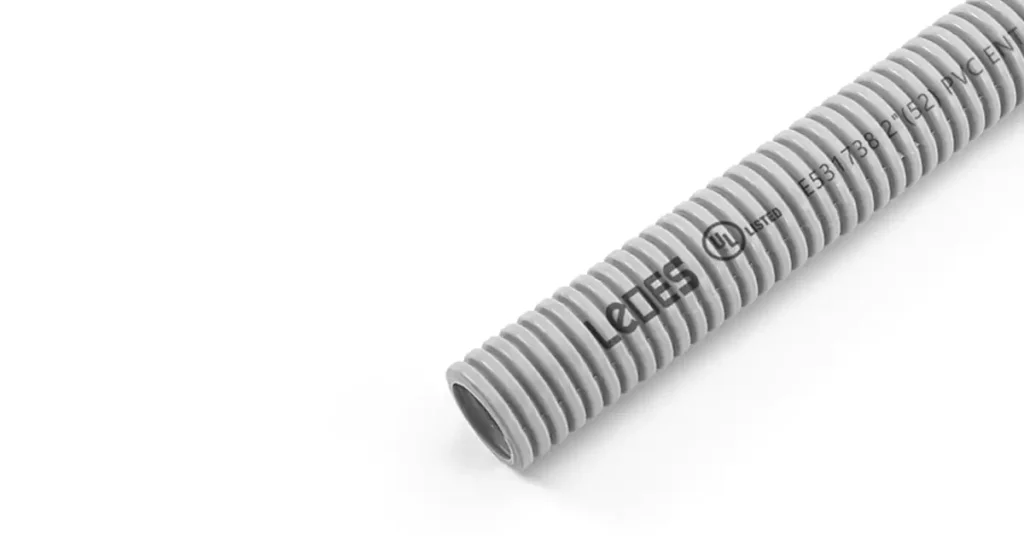
When it comes to electrical installations, it is crucial that PVC conduits meet stringent standards to ensure safety, durability, and performance. These standards are set by various organizations across the globe, each with its own set of regulations to govern PVC conduit performance in different environmental conditions. Below, we’ll summarize the key codes for PVC conduits in America, Canada, and Australia.
- UL651 : This standard covers Schedule 40 and 80 Rigid PVC Conduit for use in electrical wiring. It specifies requirements for strength, flame resistance, and other physical properties to ensure safety in installations.
- UL 1653: This standard applies to Electrical Nonmetallic Tubing (ENT), not rigid PVC conduit. It specifies construction and performance requirements for ENT systems used in electrical installations.
Remarques : If you would like to learn more about UL 651 standards for rigid PVC conduit et UL 1653 standards for ENT tubing, vous pouvez lire notre dernier article.
- CSA C22.2 No.211.2: This standard is for Rigid PVC Conduit. It sets the guidelines for the construction, performance, and testing requirements of PVC conduit used for electrical installations in Canada.
- CSA C22.2 No.211.1: This standard applies to EB1, DB2/ES2 PVC Conduit. It defines the material and performance characteristics for these specific PVC conduit types, ensuring they meet fire, mechanical, and weather resistance requirements.
Conseils de pro : Learn more about CSA standard requirements for Rigid conduit in our last post.
- AS/NZS 2053.1: This is the General Requirements Standard for PVC conduit and fittings in Australia and New Zealand. It outlines the overall specifications for materials, dimensions, and installation guidelines.
- AS/NZS 2053.2: This standard addresses Rigid Plain Conduits and Fittings, focusing on their construction, performance, and testing requirements for electrical installations.
- AS/NZS 2053.5: This standard applies to Corrugated Conduits and Fittings and covers the specifications for flexible PVC conduit used in electrical installations, ensuring durability and safety
For more detailed information about these codes, refer to our previous articles where we explore the standards for PVC conduits in depth.
Remarques : Want to learn more about AS/NZS 2053 standard? Click here to read the Ultimate Guide to AS/NZS 2053.
Electrical Code for LSZH Conduit | |
IEC 61386-1, -21, -23 | International standards that specify mechanical and electrical performance requirements for conduits (including LSZH conduit). |
EN 50276-2 | A test method for acidity and corrosiveness of gases released during the combustion. |
IEC 60754-1 | A test method for determining the amount of halogen acid gases released during the combustion. |
IEC 60754-2 | Test of acidity (pH) and conductivity of gases released during the combustion. |
IEC 61034-2 | Measures the smoke density generated when conduits burn under controlled conditions. |
ASTM E662-17a | Test for specific optical density of smoke produced by solid materials. |
ISO 4589-2 | Test method for determining the burning behaviour by oxygen index. |
UL 94 | Tests for different flammability ratings of plastic materials |
UL1685 | Evaluate the flame propagation and smoke release of conduits, including UL flame exposure test and FT4/IEEE 1202 flame exposure test.. |
NFPA 130 | Specifies the fire protection and life safety requirements for components of rail transit systems. |
Electrical Code for PVC Conduit | |
UL651 | Specifies the requirements of dimensions, mechanical strength and other performance for Schedule 40/80 PVC conduits and fittings. |
UL1653 / CSA C22.2 No.227.1 | Specifies construction and performance requirements for ENT systems. |
CSA C22.2 No.211.2 / CSA C22.2 No.211.1 | Specifies construction, performance, and testing requirements for rigid PVC conduit and DB/ES, EB type of conduits. |
AS/NZS 2053.1, .2, .5 | Specifies materials, dimensions, and performance for PVC conduits and fittings in Australia and New Zealand. |
CEI 61386 | Specifies the construction and performance for conduits (including PVC conduit) |
The durability and lifespan of an electrical conduit depend on its ability to withstand environmental exposure, mechanical stress, and aging factors. LSZH and PVC conduits differ significantly in their long-term performance under different conditions.
- conduit LSZH is designed for long-term durability in demanding environments, such as railway tunnels, industrial plants, and solar applications. It is highly resistant to UV exposure, ensuring minimal degradation when installed outdoors. Its material composition also prevents brittleness in extreme cold and softening in high heat, allowing LSZH conduit to maintain its structural integrity across a wide temperature range (-45°C to 150°C).
- Conduit en PVC, while widely used for general electrical applications, is more susceptible to environmental aging. Standard rigid PVC can become brittle under prolonged UV exposure, leading to cracking if not properly protected. But some rigid conduit can also be designed to be UV resistance. Additionally, in extreme cold (below -25°C), PVC becomes fragile, increasing the risk of impact-related breakage. At higher temperatures, above 90°C, PVC may soften and deform, limiting its lifespan in applications with high thermal exposure.
- conduit LSZH offers superior impact and compression resistance, with heavy-duty types rated at 1250N/5cm and medium-duty types at 750N/5cm. This high mechanical strength makes LSZH conduits ideal for harsh environments where physical stress, pressure, or vibrations occur, such as railway transit systems, underground installations, and areas with heavy foot or vehicle traffic.
- Conduit en PVC, also provide strong mechanical strength. Especially that Schedule 80 PVC conduit offers excellent impact resistance and strength, higher than standard Schedule 40 and even heavy duty LSZH conduit. But PVC is prone to cracking under sudden impacts in colder environments. Its long-term durability depends heavily on installation conditions, such as protection from mechanical stress, temperatures and proper burial depth in underground applications.
- conduit LSZH has an estimated lifespan of 30+ years in controlled environments, such as railway systems, underground facilities, and protected outdoor applications. Its resistance to UV damage, extreme temperatures, and mechanical stress ensures stable long-term performance.
- Conduit en PVC can last anywhere from 30 to 50 years, depending on exposure and environmental conditions. Buried PVC conduits, protected from UV exposure and mechanical damage, may last over 50 years, whereas exposed PVC conduits without UV protection can degrade in as little as 10-15 years.
When selecting between LSZH and PVC conduit, installation and maintenance are important factors that affect labor costs, ease of use, and long-term reliability. Both conduit types have their own set of handling, flexibility, and maintenance requirements, which influence their suitability for different applications.
- LSZH conduit is generally lighter than rigid PVC conduit, reducing the load on structural supports and making it easier to transport and install in elevated or suspended applications.
- PVC conduit is heavier, particularly in Schedule 80 variants, which can make handling and transport more challenging, especially in large installations. However, its rigidity offers stability in above-ground and underground installations.
- LSZH conduit requires minimal maintenance, as it is resistant to UV degradation, temperature fluctuations, and fire-related damage. This makes it ideal for installations where long-term reliability is a priority, such as transit systems and data centers.
- PVC conduit, unless UV-stabilized, can degrade over time when exposed to sunlight, leading to brittleness and reduced mechanical integrity.
- Underground installations for both LSZH and PVC require periodic inspection to check for shifting, moisture ingress, or mechanical stress.
In high-temperature or chemically aggressive environments, LSZH conduit is often preferred due to its enhanced material durability and halogen-free composition.
- LSZH conduit is specifically designed for environments requiring low smoke and halogen-free materials, making it a preferred choice for transit systems, data centers, and nuclear facilities.
- PVC conduit is widely accepted in standard electrical installations but may not be suitable for fire-sensitive areas unless additional fireproofing measures are applied.
Fonctionnalité | Conduit LSZH | Conduits en PVC |
Weight & Installation | Lighter, easier to handle and install | Heavier, harder to install especially for Schedule 80 |
Résistance aux UV | High, minimal degradation | Requires UV protection for outdoor use |
Fire Safety | Preferred in fire0sensitive environments | Acceptable in standard electrical installations |
Long-term Maintenance | Lower maintenance, durable over time | May require UV protection and may crack in lower temperatures |
When evaluating LSZH and PVC conduits, their impact on the environment, human health, and fire safety must be considered. LSZH is designed to minimize toxic emissions and environmental hazards, while PVC, though widely used, raises concerns due to its chlorine-based composition and disposal challenges.
Conduit LSZH :
- LSZH (Low Smoke Zero Halogen) does not contain chlorine, fluorine, bromine, or iodine, meaning no toxic halogen gases are released during combustion.
- In the event of a fire, LSZH produces minimal smoke and lower levels of toxic gases, reducing risks of suffocation and increasing evacuation time.
- LSZH conduits significantly improve air quality in enclosed spaces, making them ideal for rail transit, tunnels, hospitals, and data centers.
Conduits en PVC :
- PVC contains chlorine, which, when burned, can release hydrogen chloride (HCl) and dioxins, both of which are hazardous to human health and the environment.
- Hydrogen chloride gas is highly corrosive and can cause severe respiratory irritation, while dioxins are persistent environmental pollutants (PEPs) linked to long-term ecological damage.
- In fires, PVC conduits produce dense smoke, which can impair visibility and hinder emergency response efforts.
- LSZH conduits contribute to improved fire rescue conditions by reducing smoke density and toxic gas buildup, allowing emergency personnel to operate more effectively.
- In enclosed environments (e.g., railway tunnels, aircraft, nuclear plants, and submarines), LSZH is preferred to minimize risks associated with smoke inhalation and toxic gas exposure.
- PVC conduit, unless specially treated, may release thick smoke and toxic compounds, which can compromise evacuation routes and slow down rescue operations.
LSZH Conduit: Limited Recycling Options
LSZH materials do not contain halogens or heavy metals, reducing environmental contamination at disposal.
However, LSZH plastics are more difficult to recycle due to their specialized composition, often requiring controlled disposal methods.
Unlike PVC, LSZH does not emit harmful dioxins when incinerated, making thermal disposal a safer option.
PVC Conduit: Recycling Limitations & Dioxin Risks
PVC can be mechanically recycled, but only a small percentage of PVC waste is actually recycled due to contamination risks.
When incinerated, PVC releases toxic dioxins, contributing to long-term environmental pollution.
Landfilling PVC waste poses risks as plasticizers and chlorine-based additives can leach into the soil and water systems, affecting ecosystems.
- LSZH conduit aligns with modern sustainability goals, especially in industries prioritizing low-toxicity materials and reduced carbon footprints.
- PVC conduit remains widely used due to its durability and cost-effectiveness, but its environmental drawbacks are pushing industries toward greener alternatives.
- Regulations are increasingly favoring halogen-free materials, making LSZH a future-proof choice in environmentally conscious infrastructure projects.
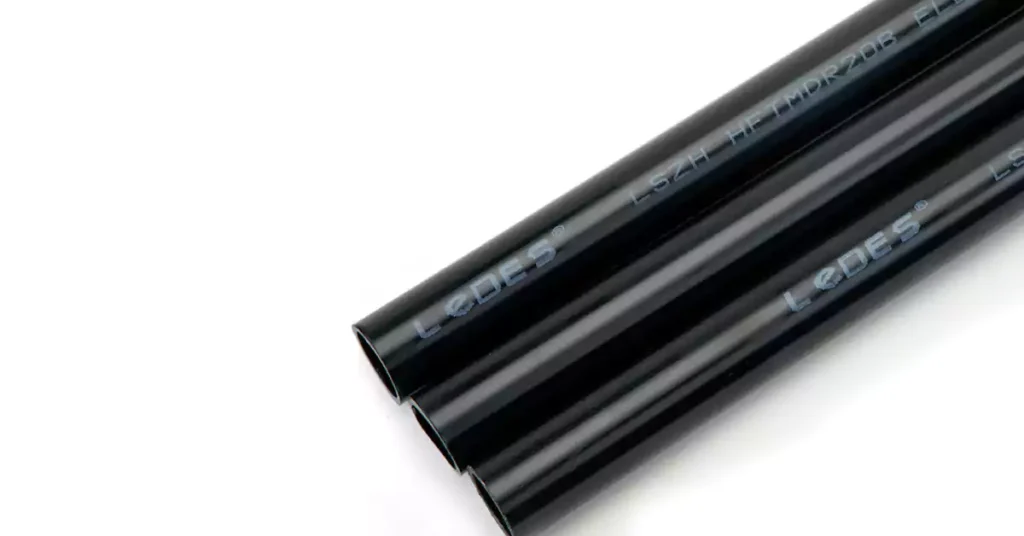
Both LSZH and PVC conduits must comply with specific marking requirements as defined by their respective standards. Markings ensure that the conduits are properly identified for compliance, installation suitability, and traceability. These markings generally include standard references, manufacturer information, size, type, and application-specific ratings.
Follow are some common marking requirements for them:
The phrase “rigid PVC conduit”
Schedule rating: Schedule 40 or 80
The complied standard
The trade size of the conduit product
The name or trademark of the manufacturer
The date or other dating period of manufacture
For Schedule 40 and 80 rigid PVC conduit that intended to used with 90 Degrees Celsius wires, should include “maximum 90°C wire” or “max 90°C”.
The phrase “LSZH or LSOH conduit”
The complied standard
The size of the conduit
The name or trademark of the manufacturer
Mechanical strength, such as “MD or HD”
Flammability rating: UL94 V-0 or 5VA
Écart de température
La date de fabrication
Choosing the right conduit for an electrical system is crucial for safety, compliance, and long-term performance. LSZH (Low Smoke Zero Halogen) conduit is specifically designed for fire-sensitive environments where toxic smoke and halogen emissions could endanger lives and damage critical infrastructure.
LSZH conduit is the preferred choice in areas where fire safety, low toxicity, and minimal smoke production are essential. These environments include:
- Rail & Metro Systems – Underground train tunnels, subway stations, and elevated railways require LSZH conduit to comply with NFPA 130 and international transit safety standards. Ledes LSZH conduit was successfully deployed in the Melbourne Metro Tunnel Project, where strict fire and smoke regulations were enforced to protect passengers and infrastructure.
- Airports & Aviation Facilities – Enclosed airport terminals, control towers, and baggage handling areas need LSZH conduit to minimize smoke and toxic gas exposure in the event of a fire.
- Underground Tunnels & Enclosed Spaces – Locations with limited ventilation, such as utility tunnels and mines, benefit from LSZH conduit since it reduces smoke density and allows for better evacuation visibility.
- Hospitals & Healthcare Facilities – In medical environments, toxic halogen gas from burning PVC conduit could pose serious health risks to patients and sensitive medical equipment. LSZH conduit ensures a safer alternative that meets strict fire and safety codes.
- Data Centers & IT Infrastructure – With the increasing reliance on cloud computing and critical digital infrastructure, data centers require fire-safe and non-corrosive conduit solutions. LSZH conduit prevents damage to expensive servers and network systems by reducing acidic gas emissions that could corrode electronic components.
- Electric Vehicle Charging Stations & Renewable Energy Projects – The growth of EV infrastructure and renewable energy demands safe, fire-resistant conduit systems. LSZH conduit is an excellent choice for EV charging hubs, solar farms, and wind power stations, where electrical safety and long-term reliability are key considerations.
Regulatory compliance plays a critical role in determining whether LSZH conduit is necessary. Many national and international standards specify LSZH conduit for fire-sensitive applications:
- NFPA 130 (Rail Transit Fire Safety Standard) – Requires the use of LSZH materials in enclosed railway systems.
- IEC 61386 (Conduit System Standards) – Defines LSZH performance requirements, including smoke density, halogen content, and fire resistance.
- EN 50267 (Toxicity & Corrosiveness Testing) – Ensures LSZH conduit meets low-emission and non-corrosive standards.
- UL 94 V-0 / 5VA (Flammability Rating) – Confirms superior fire resistance of LSZH conduit compared to traditional PVC.
In high-risk environments, the choice between LSZH and PVC conduit is clear: LSZH conduit provides superior fire safety, lower toxicity, and better protection for both people and equipment.
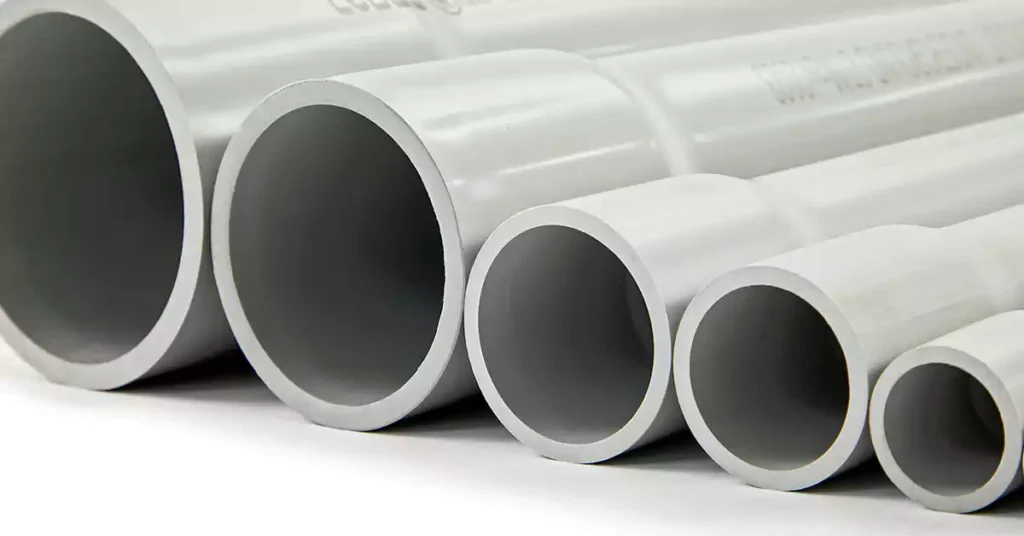
While LSZH conduit is ideal for high-risk environments, PVC conduit remains the most commonly used option for general electrical installations due to its affordability, versatility, and ease of installation. PVC conduit is the best choice when fire safety requirements are less stringent, and cost efficiency is a priority.
PVC conduit is widely used in standard industrial, commercial, and residential electrical systems where fire safety, toxicity, and smoke production are not primary concerns. These include:
Commercial & Residential Electrical Wiring – PVC conduit is commonly used for home wiring, office buildings, and retail spaces, providing an economical and easy-to-install solution. It is particularly effective in drywall installations, concrete embedding, and above-ground conduit runs.
Industrial Facilities & Warehouses – In manufacturing plants, warehouses, and large-scale storage units, PVC conduit is an excellent choice for general electrical protection in areas that do not require halogen-free materials.
Outdoor & Utility Installations – PVC conduit is suitable for outdoor electrical runs, solar installations, and telecommunications infrastructure, thanks to its UV-resistant and corrosion-resistant properties. However, in extreme high-heat environments, alternative materials like HDPE or LSZH may be preferred.
Underground & Direct Burial Applications – Rigid PVC conduit, including DB2, EB1, and Schedule 40/80, is a popular option for direct burial installations in commercial, residential, and industrial projects. It offers excellent resistance to moisture, soil chemicals, and mechanical damage when installed with proper fittings.
PVC conduit is significantly more cost-effective than LSZH conduit, making it the preferred choice for projects that prioritize affordability over fire performance.
Lower Material & Installation Costs – Compared to LSZH conduit, PVC conduit is cheaper per unit and does not require specialized fittings or installation techniques.
Disponibilité – PVC conduit is widely available, making it a practical choice for large-scale projects that require fast procurement.
However, in environments where fire safety, toxicity, and smoke production are critical concerns, LSZH conduit is the better option despite the higher cost.
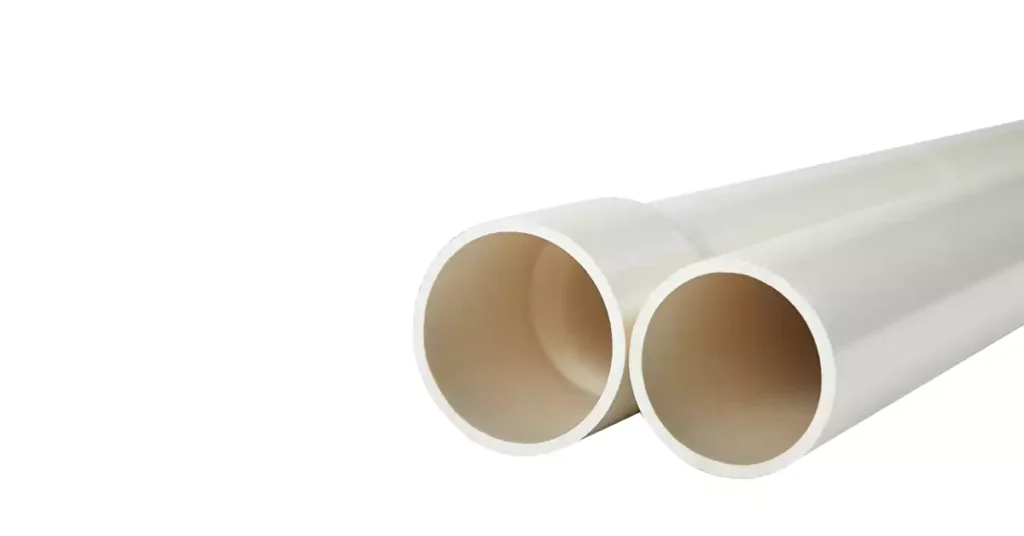
Selecting the appropriate conduit depends on several factors, including budget, safety requirements, installation environment, and regulatory compliance. Each project has unique demands, and understanding these considerations will help in making an informed choice between LSZH and PVC conduit.
Key Factors to Consider:
If the project is in a high-risk environment where fire safety is a priority (e.g., tunnels, railways, data centers, or hospitals), LSZH conduit is the better choice due to its low smoke and halogen-free properties. PVC conduit may be sufficient for general applications where fire risk is minimal.
LSZH conduits generally cost more than PVC due to their specialized materials and fire-resistant properties. For cost-sensitive projects that do not require high fire safety compliance, PVC is often preferred.
LSZH is the more environmentally friendly option, as it does not release toxic halogens or corrosive gases during combustion. If sustainability and reduced emissions are priorities, LSZH is the better choice. However, PVC offers better recyclability in controlled conditions.
Outdoor installations exposed to direct sunlight and varying temperatures require UV-resistant conduit. In enclosed spaces with limited ventilation, LSZH is recommended to reduce toxic emissions in case of a fire.
For areas facing high stresses and forces, Schedule 80 PVC conduit may be more suitable. Heavy duty LSZH conduit, while offering high mechanical strength as well, but not as good as Schedule 80 under normal installation temperatures.
Ensure the conduit meets local codes and standards (e.g., UL, CSA, AS/NZS) based on regional and industry-specific requirements. Certain industries, such as transportation systems and hospitals, may mandate LSZH use.
By carefully assessing these factors, project planners and engineers can make the best decision on whether LSZH or PVC conduit is the most suitable option for their specific application.
Choosing between LSZH conduit and PVC conduit ultimately comes down to understanding the specific needs of your project.
Throughout this article, we explored their key differences — from toxicity and fire safety, durability and lifespan, installation and maintenance considerations, to their environmental impact and compliance with various codes and standards.
In short:
- Conduits LSZH excel in environments where fire safety, low toxic emissions, and strict regulatory compliance are top priorities — such as subways, tunnels, hospitals, airports, and data centers.
- Conduits en PVC, on the other hand, are a great solution for standard industrial, commercial, and residential applications, offering cost-effective and easy-to-install options where fire risk is lower.
Final Recommendation:
Always align your conduit choice with your project’s safety requirements, environmental goals, budget constraints, and regulatory needs. Selecting the right type will not only ensure long-term performance but also significantly improve overall project safety.
Need help choosing the right conduit?
Feel free to contact us to request product catalogs, technical support, and competitive quotations.
We are happy to assist you with selecting the most suitable solutions for your specific project needs!
FAQ
Quelle est la différence entre les conduits LSZH et les conduits en PVC ?
To have a more clear understanding of the differences between LSZH and PVC conduit, here is the comparison table for reference:
LSZH Vs PVC Conduit Table
Fonctionnalité | Conduit LSZH | Conduits en PVC |
Smoke and Toxicity | Releases low smoke and non-halogenated gases during fire, safer for evacuation and rescue. | Can release toxic and corrosive gases (like hydrogen chloride) during combustion. |
Ideal Applications | Used in high-safety environments like airports, tunnels, hospitals, data centers, and railways. | Suitable for general industrial, commercial, and residential projects. |
Environmental Impact | Halogen-free, helps reduce environmental pollution. | Contains chlorine; incineration can produce dioxins. |
Durabilité | Strong impact resistance, compression strength, and wide temperature tolerance. | Excellent mechanical performance; needs UV protection and thermal expansion considerations outdoors. |
Coût | Generally higher cost due to material and performance advantages. | More affordable, ideal for cost-sensitive projects without strict fire safety needs. |
Standards Compliance | Meet strict standards of smoke, fire and other performance requirements, such as IEC 61386, IEC 60752, ASTM E662, UL 94, UL1685, NFPA 130 etc. | Certified under standards like UL651, CSA C22.2 No.211.2, IEC 61386, AS/NZS 2053 and other standards that required by local codes. |
Les conduits LSZH et PVC peuvent-ils être utilisés ensemble ?
Technically, yes — but it depends on the project requirements and safety standards.
- Fire Safety and Compliance:
In critical environments (like tunnels, airports, hospitals), mixing LSZH and PVC is usually not recommended. Many fire safety codes require the entire system — including conduits, fittings, and cables — to meet low-smoke, halogen-free standards. Using PVC alongside LSZH could compromise the overall fire performance and regulatory compliance. - Standard Industrial or Commercial Projects:
In less critical projects (like general commercial buildings or factories), using LSZH and PVC together is possible if the system does not have strict halogen-free requirements. For example, you might use LSZH conduit in sensitive areas (e.g., server rooms) and PVC elsewhere to save costs.
- Practical Considerations:
Connection compatibility: LSZH and PVC conduits typically use different formulations, but dimensions can be similar, especially when following standards like UL or CSA. Standard PVC fittings might physically fit LSZH conduits and vice versa, but check material compatibility if high mechanical strength or long-term sealing is important.
System Integrity: Mixing different material properties (thermal expansion, chemical resistance) could cause issues over time, especially in outdoor or extreme environments.
Conclusion
If your project prioritizes fire safety, toxicity control, or must follow strict codes (e.g., NFPA 130 for transit tunnels), don’t mix LSZH with PVC — stick with full LSZH systems.
If your project has no halogen-free requirements and budget optimization is important, mixing may be acceptable — but it should be clearly documented and approved by the engineering team
Le LSZH est-il toujours meilleur que le PVC ?
Not always — it really depends on the project’s needs. Here’s a simple breakdown:
- Depends on the Application: LSZH conduit excels in environments where fire safety and low toxicity are critical, such as tunnels, hospitals, airports, and data centers. However, in open areas or projects without strict fire safety demands, PVC conduit is often a more practical and cost-effective choice.
- Fire and Smoke Performance: LSZH conduit produces far less smoke and no halogen gases when exposed to fire, making it safer for people and sensitive equipment during an emergency. PVC, on the other hand, can release dense smoke and corrosive gases when burning.
- Considérations relatives aux coûts : LSZH conduit is usually more expensive than standard PVC conduit. For projects with tight budgets and less critical fire safety needs, PVC can be the more economical option.
- Durability and Environmental Factors: Both materials are durable, but they have different strengths. For extreme temperatures, LSZH performs better than PVC. LSZH is especially chosen for its low-toxicity fire behavior and weathering performance, while PVC is often choose for installations where face high external forces, especially Schedule 80 rigid PVC conduit.
Les références:
IEC 61386-1: Conduit systems for cable management – Part 1: General requirements
UL Combustion (Fire) Tests for Plastics
UL 1685 – Smoke-Release Test for Cables and Conduit
IEEE Standard for Flame-Propagation Testing of Wire and Cable
NFPA 130: Standard for Fixed Guideway Transit and Passenger Rail Systems



 EN
EN  FR
FR  ES
ES  ES_MX
ES_MX  PT
PT  AR
AR  DE
DE  KO
KO  ZH
ZH