Aller au contenu

Table des matières
1. Introduction
Choisir le bon type de conduit pour un projet d'électricité ou de plomberie peut s'avérer plus complexe qu'il n'y paraît.
Avec la variété d'options disponibles – conduits en PVC Sch 40, Sch 80, Type A et Type EB – il est facile d'être submergé par les détails techniques tels que l'épaisseur de la paroi, les pressions nominales, la durabilité des matériaux et les normes de certification.
Choisir le mauvais conduit peut non seulement affecter la longévité et la sécurité de votre installation, mais aussi entraîner des coûts et des complications inutiles lors de la construction.
Plutôt que d'examiner chaque type isolément, nous les comparerons côte à côte en fonction de plusieurs facteurs clés, tels que l'épaisseur de la paroi, la pression nominale, la durabilité, l'adéquation environnementale, le coût et la certification.
En présentant toutes ces informations au même endroit, nous visons à rendre votre processus de sélection des conduits plus rapide, plus clair et plus fiable. À la fin de cet article, vous serez capable de :
Savoir choisir le type de conduit approprié : Comprenez rapidement les différences entre les types Sch 40, Sch 80, Type A et Type EB, et quand utiliser chacun d'eux.
Mettez ces connaissances en pratique à des projets concrets : Découvrez les performances de chaque type dans les applications résidentielles, commerciales et industrielles, qu'elles soient intérieures, extérieures ou souterraines.
Évitez les erreurs courantes : Découvrez comment éviter les problèmes tels que l'utilisation d'un type de conduit inapproprié ou de raccords incompatibles.
Faites des choix éclairés et fondés sur des données : Utilisez les données techniques pour équilibrer coût, durabilité et performance lors de chaque installation.
2. Comparaison des conduits : Sch 40 vs Sch 80 vs Type A vs Type EB
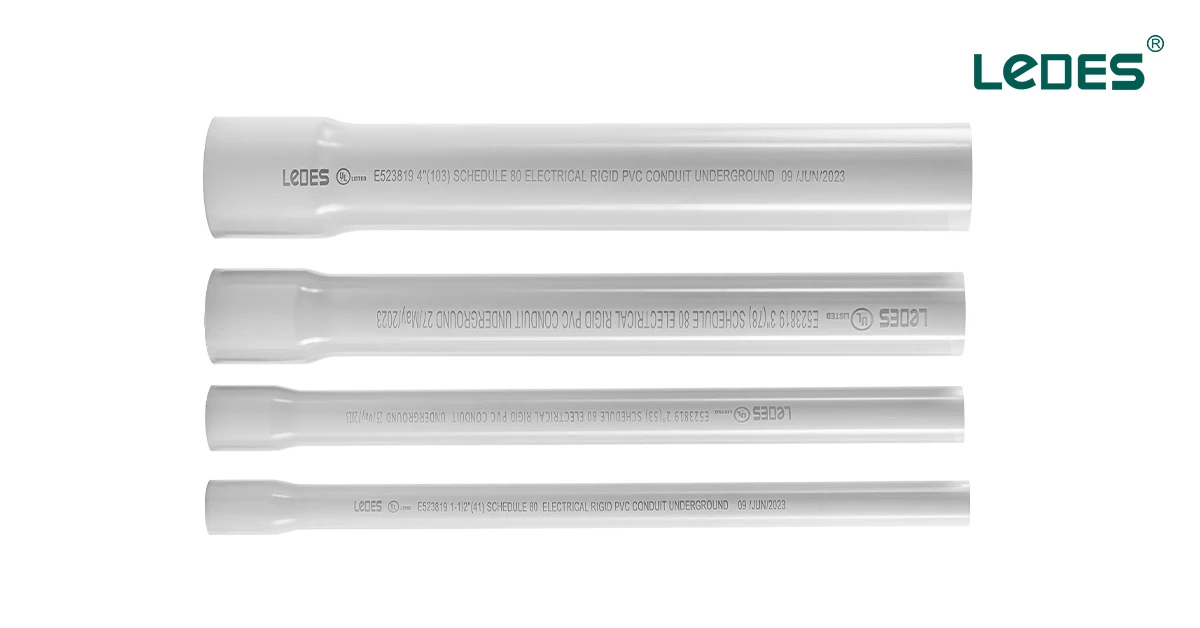
Le choix du conduit approprié commence par la compréhension des deux principaux systèmes de classification utilisés aux États-Unis et au Canada : Calendrier et Taper. Bien que ces systèmes soient parfois présentés côte à côte, ils décrivent des caractéristiques très différentes. Comprendre leur fonctionnement — et les performances de chaque type de conduit — est essentiel pour choisir le conduit le plus adapté.
2.1 Ce que signifie réellement le terme “ horaire ” (Sch 40 et Sch 80)
Le Calendrier La notation se réfère principalement à épaisseur de paroi, une spécification qui influe directement sur la résistance, la résistance aux chocs et la protection mécanique d'un conduit.
- Sch 40 représente l'épaisseur de paroi standard couramment utilisée dans le câblage résidentiel, les projets commerciaux et les installations hors sol.
- Sch 80 a considérablement murs plus épais, ce qui lui confère une durabilité accrue et une meilleure résistance aux forces extérieures telles que les chocs ou les contacts avec des équipements.
L'épaisseur des parois augmentant avec le numéro de série, ces conduits diffèrent de plusieurs manières pratiques :
- Protection mécanique: Le Sch 80 offre une meilleure protection dans les endroits exposés ou les zones susceptibles de subir des dommages physiques.
- Tolérance à la chaleur et à la pressionLes parois plus épaisses conservent mieux leur forme sous charge ou à des températures élevées.
- Poids et effort d'installationLe câble Sch 40 est plus léger et plus facile à manipuler, ce qui le rend adapté aux itinéraires de câblage courants.
2.2 Que représente le terme “ type ” (type A et type EB) ?
Alors que les cotes de classement décrivent une dimension physique, Classifications de type sont définis autour l'objectif et l'environnement de performance prévus du conduit. Ces classifications sont largement reconnues aux États-Unis et au Canada et sont généralement associées aux normes CSA.
Les conduits de type A sont conçus pour systèmes électriques intérieurs à usage général.
Leurs caractéristiques comprennent :
- Épaisseur de paroi modérée
- Manipulation et découpe faciles
- Compatibilité avec les raccords standard
- Protection suffisante pour les environnements contrôlés
Cela rend le type A idéal pour les murs, les plafonds, les locaux techniques, les salles d'équipement et autres zones où les conducteurs ne subissent pas de contraintes mécaniques externes.
Type EB, abréviation de Sépulture en cercueil, est spécifiquement conçu pour installations électriques souterraines où le conduit est enrobé de béton ou d'enrobages protecteurs similaires. Il n'est pas conçu pour une utilisation en extérieur, à l'abri des regards.
Les principales caractéristiques de performance sont les suivantes :
- Construction à parois plus épaisses que les conduits de type A
- Résistance accrue aux chocs lors de l'installation
- Capacité accrue à résister aux charges du sol et à la pression externe
- Durabilité à long terme dans les environnements souterrains sujets à l'humidité
Le conduit de type EB est généralement installé sous trottoirs, espaces paysagers, parkings et routes, où il est enrobé de béton pour assurer le soutien structurel et la fiabilité à long terme du système conformément aux codes électriques applicables.
2.3 Pourquoi les deux systèmes coexistent en Amérique du Nord
Les classifications par programme et par type sont toutes deux largement utilisées dans le États-Unis et Canada, mais chacune a évolué pour répondre à des besoins différents :
- Le Calendrier Ce système est conforme aux normes ASTM/UL et met l'accent sur la constance dimensionnelle et la résistance mécanique.
- Le Taper Le système s'aligne plus étroitement sur les catégories de performance de la CSA, en mettant l'accent sur l'endroit et la manière dont le conduit sera utilisé.
En pratique, les électriciens, les ingénieurs et les inspecteurs rencontrent les deux systèmes régulièrement. De nombreux fabricants de conduits en PVC proposent des produits Sch 40/80 en plus des gammes de type A et de type EB car Les homologations UL et CSA sont souvent complémentaires. dans les projets nord-américains.
Cet environnement à double norme permet aux concepteurs de projets de choisir les conduits en fonction de fonction, et pas seulement l'épaisseur de la paroi.
3. Dimensions et épaisseur de paroi : Conduits de type Schedule 40, Schedule 80, Type A et Type EB
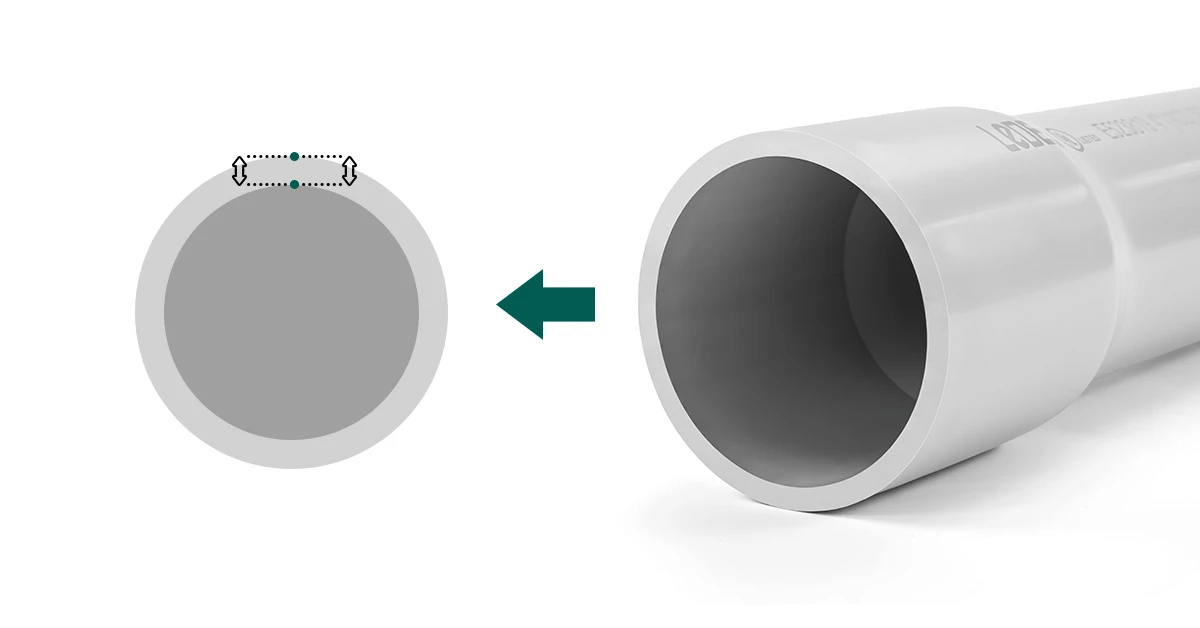
Un contrôle dimensionnel précis est l'un des indicateurs de qualité les plus importants pour les conduits électriques en PVC. Bien que les conduits de type Schedule 40, Schedule 80, Type A et Type EB répondent à des exigences structurelles et de performance différentes, l'évaluation de leur diamètre et de leur épaisseur de paroi poursuit le même objectif fondamental : garantir un ajustement parfait, une résistance mécanique optimale et la conformité aux normes d'installation électrique.
Tous les types de conduits sont mesurés à l'aide de pieds à coulisse micrométriques de précision. Les diamètres extérieurs sont enregistrés au millième de pouce près et l'épaisseur de paroi est calculée en faisant la moyenne de plusieurs points de mesure. Cette méthode de mesure unifiée permet de comparer de manière cohérente les performances dimensionnelles des différentes catégories de conduits.
Conduits de type Schedule 40 et Schedule 80 Elles présentent généralement les parois les plus épaisses car elles sont destinées à des applications nécessitant une protection mécanique plus robuste.
Annexe 80, En particulier, elle présente une épaisseur de paroi considérablement accrue pour toutes les tailles commerciales, offrant une meilleure résistance à l'écrasement et une résistance à la traction supérieure.
conduit de type A, En comparaison, il est fabriqué avec des exigences d'épaisseur de paroi moins strictes, ce qui convient aux installations où la flexibilité et la facilité de manipulation sont privilégiées par rapport à une protection renforcée.
conduit de type EB—conçu principalement pour l'enrobage en béton ou les systèmes de conduits souterrains—présente sa propre gamme dimensionnelle, avec une épaisseur de paroi généralement plus mince que le Schedule 40/80 mais contrôlée pour répondre aux exigences d'enfouissement et d'enrobage.
Taille du commerce | Épaisseur minimale de paroi (Schedule 40, pouces) | Épaisseur minimale de paroi (Schedule 80, pouces) | Épaisseur minimale de paroi (Type A, pouces) | Épaisseur minimale de paroi (Type EB, pouces) |
1/2 | 0.109 | 0.147 | 0.060 | – |
3/4 | 0.113 | 0.154 | 0.060 | – |
1 | 0.133 | 0.179 | 0.060 | – |
1-1/4 | 0.140 | 0.191 | 0.070 | – |
1-1/2 | 0.145 | 0.200 | 0.080 | – |
2 | 0.154 | 0.218 | 0.100 | 0.060 |
2-1/2 | 0.203 | 0.276 | 0.110 | – |
3 | 0.216 | 0.300 | 0.125 | 0.061 |
3-1/2 | 0.226 | 0.318 | 0.145 | 0.072 |
4 | 0.237 | 0.337 | 0.150 | 0..82 |
5 | 0.258 | 0.375 | – | 0.103 |
6 | 0.280 | 0.432 | – | 0.125 |
NoteLes données ci-dessus sont fournies à titre indicatif uniquement. Les valeurs réelles peuvent varier selon les normes et les spécifications du fabricant. Des différences entre fournisseurs sont normales, pourvu qu'ils respectent les codes et normes en vigueur.
4. Exigences d'essai et comparaison des performances : Schedule 40, Schedule 80, Type A et Type EB
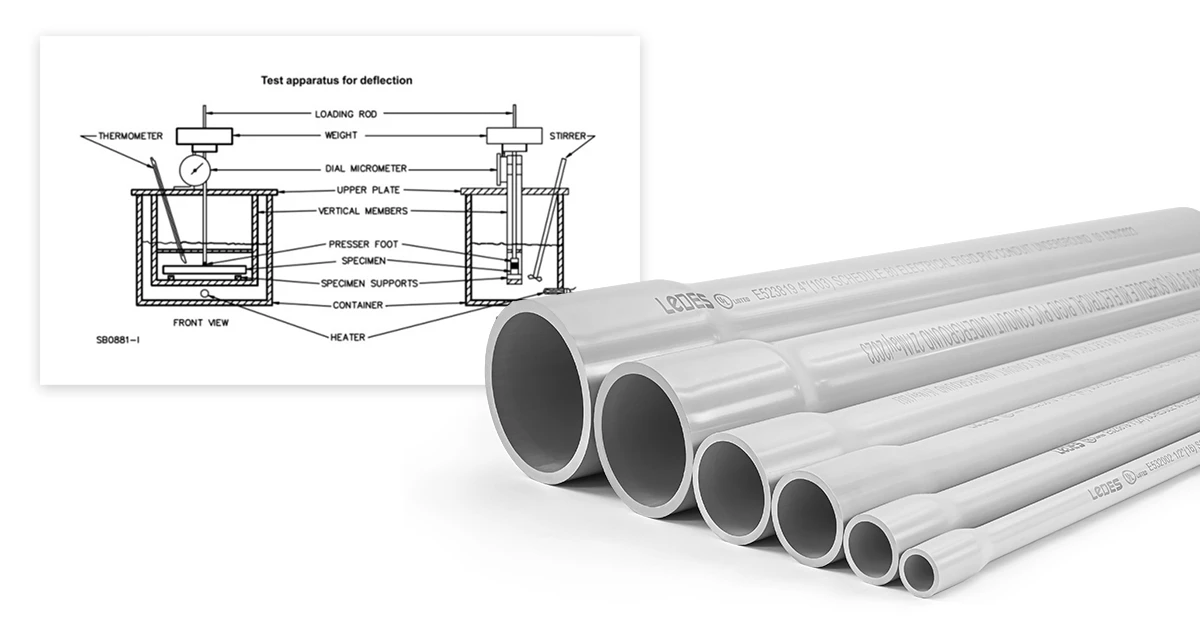
Les tests des conduits en PVC rigide, qu'ils soient de type Schedule 40, Schedule 80, Type A ou Type EB, suivent un cadre unifié basé sur les exigences UL 651.
Tous les types de conduits sont soumis à plusieurs essais mécaniques fondamentaux visant à vérifier la qualité des matériaux, la stabilité dimensionnelle et les performances structurelles à long terme. Toutefois, la norme introduit également des procédures spécifiques à chaque type, notamment pour la préparation des éprouvettes de traction, où la géométrie de chaque conduit impose des méthodes d'usinage différentes.
Cette section explique à la fois les tests communs à tous les types de conduits et les principales différences qui distinguent le Schedule 40/80 du type A et du type EB.
Conseils de pro : Vous voulez en savoir plus sur Éléments de test UL 651 et différence avec la norme CSA ? Lisez l'analyse de nos experts en cliquant sur le lien ci-dessus.
Essai de résistance à la traction (UL 651 Section 6.2)
Tous les conduits doivent être testés pour leur résistance à la traction, en comparant des échantillons non vieillis à des échantillons vieillis.
Les échantillons vieillis doivent conserver au moins 95% de la résistance à la traction des échantillons non vieillis.
Les exigences minimales en matière de résistance à la traction varient selon le type de produit :
- Série 40 et série 80 : ≥ 5 000 psi
- Type A et type EB : ≥ 4 000 psi
Tous les types de conduits suivent également les mêmes exigences en matière de conditionnement environnemental (23 ± 2°C), de précision de mesure (0,0001 pouce) et de régularité des matériaux.
Tests de mesure dimensionnelle
Chaque échantillon de conduit doit être soumis à des procédures de mesure dimensionnelle uniformes :
- Diamètres extérieurs mesurés aux deux extrémités et au centre
- Au moins quatre relevés par emplacement, espacés de 45°.
- Épaisseur de paroi mesurée à l'aide d'enclumes hémisphériques
Ces mesures garantissent la concentricité, un dimensionnement correct et le respect des limites de diamètre/épaisseur de paroi publiées.
Exigences en matière de vieillissement, de conditionnement et de qualité de surface
Avant les tests :
- Les échantillons doivent rester propres et thermiquement stabilisés.
- Les surfaces de coupe doivent être lisses, sans rayures et poncées dans le sens de l'axe longitudinal.
Ces exigences communes garantissent l'uniformité et éliminent les défauts de traitement susceptibles d'affecter les résultats mécaniques.
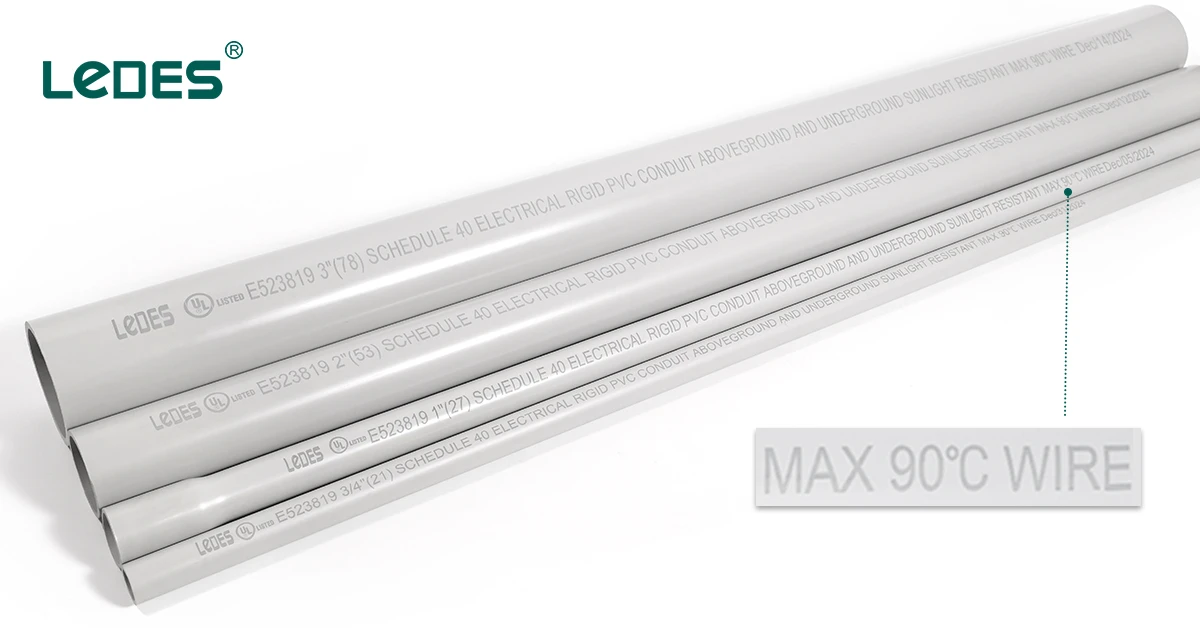
De plus, conformément à la norme UL 651 et aux normes CSA correspondantes, les conduits rigides en PVC destinés à être utilisés avec des câbles à 90 °C doivent subir une évaluation prolongée de vieillissement accéléré et de résistance aux chocs, pouvant aller jusqu'à 360 jours. Ces tests visent à vérifier que le conduit ne subit pas de dégradation significative de ses propriétés mécaniques, notamment de sa résistance aux chocs, lorsqu'il est exposé à des températures de fonctionnement élevées pendant une période prolongée.
Il est important de noter que ces tests sont réalisés par des organismes de certification tiers indépendants, tels que UL, CSA ou ETL, et non par le fabricant lui-même. Seuls les conduits ayant réussi ces évaluations sont autorisés à porter un marquage permanent indiquant leur compatibilité avec des câbles de température maximale de 90 °C.
Les produits certifiés, notamment les conduits rigides en PVC Ledes, sont fabriqués et testés pour répondre à ces exigences rigoureuses., Offrir aux ingénieurs, aux entrepreneurs et aux inspecteurs une plus grande confiance dans un large éventail d'applications.
5. Essais de résistance mécanique (impact, aplatissement, traction) – Analyse des performances mécaniques

Alors que la section 3 portait sur les caractéristiques dimensionnelles des conduits de type 40, 80, A et EB, cette section compare leurs performances mécaniques dans des conditions d'essai normalisées, mettant en évidence à la fois les procédures de test communes et les différences qui distinguent chaque type de conduit.
5.1 Procédures de test partagées
Les quatre types de conduits suivent la Cadre UL 651 pour les essais mécaniques, garantissant la cohérence de l'évaluation de la qualité des matériaux, de la stabilité structurelle et de la durabilité à long terme. Les principaux essais :résistance à la traction, résistance aux chocs (Izod) et résistance à l'aplatissement/à la compression—sont réalisées dans des conditions environnementales contrôlées, avec des outils de mesure précis, afin de garantir la comparabilité.
Les principales procédures partagées comprennent :
- Vérification dimensionnelle avant les essais : Tous les échantillons sont mesurés en diamètre extérieur et en épaisseur de paroi à l'aide de pieds à coulisse micrométriques et d'enclumes hémisphériques afin de garantir leur conformité aux dimensions nominales.
- Préparation de l'échantillon : Les surfaces de coupe doivent être lisses, sans rayures et parallèles à l'axe longitudinal. Tout défaut de courbure ou d'usinage entraîne le rejet de l'échantillon.
- Conditionnement environnemental : Les échantillons sont stabilisés thermiquement avant les essais afin d'éliminer les contraintes résiduelles dues à la fabrication ou à la manipulation.
- Méthode de test d'impact : Les essais d'impact au pendule Izod sont réalisés conformément à la norme ASTM D 256, en utilisant des éprouvettes entaillées pour évaluer l'absorption d'énergie et la fragilité.
- Essais d'aplatissement/de compression : Les conduits sont comprimés entre des plaques parallèles à des vitesses contrôlées afin d'évaluer leur résistance au flambage, garantissant ainsi que le tuyau résiste aux charges externes.
Type de conduit | résistance à la traction minimale | Notes sur la performance |
Annexe 40 | ≥ 5 000 psi | Conçu pour la protection mécanique générale ; conserve ≥95% de résistance après vieillissement. |
Annexe 80 | ≥ 5 000 psi | Des parois plus épaisses offrent une résistance à l'écrasement supérieure et une résistance ultime plus élevée. |
Type A | ≥ 4 000 psi | La paroi plus légère permet une manipulation plus facile ; la rétention de traction est légèrement inférieure à celle du Schedule 40/80. |
Type EB | ≥ 4 000 psi | Optimisé pour l'enrobage ou l'enfouissement dans du béton ; performances équilibrées avec un contrôle dimensionnel. |
Tous les types de conduits subissent le même vérification géométrique de l'échantillon et conditionnement environnemental, mais les seuils de résistance à la traction minimaux diffèrent selon l'application prévue et l'épaisseur de la paroi.
5.2 Comparaison de la résistance aux chocs (Izod)
- Programme 40/80 : Une épaisseur de paroi plus importante contribue à une absorption d'énergie plus élevée et à une plus grande résistance à la fissuration.
- Type A : résistance aux chocs modérée, suffisante pour les installations standard mais inférieure à la norme Schedule 80.
- Type EB : résistance aux chocs comparable au type A mais optimisée pour les applications souterraines ou encastrées.
Les éprouvettes entaillées de tous types sont testées de manière identique ; les différences proviennent principalement de épaisseur de paroi et formulation du matériau, influençant les valeurs d'impact absolues.
5.3 Résistance à l'aplatissement/à la compression
- Programme 80 : démontre la plus grande résistance au flambage sous charges axiales, suivie par le Schedule 40.
- Type A : Résistance à la compression inférieure en raison de l'épaisseur de paroi réduite ; convient aux environnements non soumis à des conditions d'utilisation intensives.
- Type EB : adapté aux conditions d'enrobage ; parois plus minces que celles du Schedule 40/80 mais suffisamment rigides pour répondre aux exigences d'enfouissement et d'enrobage dans le béton.
5.4 Tests environnementaux et de durabilité – Performances aux UV, à la chaleur, au froid et aux intempéries
Suite à l'analyse des performances mécaniques présentée dans la section 3.2, cette section compare les résistance environnementale et durabilité des conduits en PVC de type 40, 80, A et EB. L'objectif est de mettre en évidence normes d'essai partagées tout en identifiant principales différences dans la façon dont chaque type de conduit résiste à l'exposition aux UV, aux hautes et basses températures, et aux intempéries.
Procédures partagées d'essais environnementaux
Tous les types de conduits sont évalués selon Pratiques référencées selon les normes UL 651 et ASTM, garantissant ainsi une base de comparaison cohérente :
- Résistance aux UV : Mené avec exposition à la lumière à arc au xénon (ASTM G 155), simulant la lumière du soleil et incluant des pulvérisations d'eau intermittentes pour reproduire les conditions d'exposition aux intempéries. Des éprouvettes entaillées sont exposées pendant des cycles définis (par exemple, 720, 1080, 1440 heures), la résistance aux chocs étant mesurée après chaque intervalle.
- Résistance à la chaleur : Les échantillons sont vieillis dans une étuve à air pulsé à température contrôlée. Après conditionnement thermique, leurs propriétés de traction et de résistance aux chocs sont mesurées afin de vérifier que le conduit conserve au moins 95 % de ses performances mécaniques initiales.
- Résistance au froid : Les performances à basse température sont vérifiées en conditionnant des échantillons dans des environnements réfrigérés et en effectuant des tests d'impact ou d'aplatissement pour s'assurer que le conduit reste ductile et ne se fissure pas.
- Résistance à l'eau, à l'huile et aux produits chimiques : Les échantillons sont immergés dans de l'eau, de l'huile ou d'autres liquides appropriés à des températures contrôlées pendant des périodes spécifiées, puis testés pour leur résistance à la traction, leur stabilité dimensionnelle et la qualité de leur surface.
Pour tous les types de conduits, La préparation des échantillons, la précision des mesures et les cycles de test sont identiques., permettant une comparaison directe de la durabilité environnementale.
Type de conduit | Comportement aux UV et aux intempéries | Notes sur la performance |
Annexe 40 | Bonne résistance ; rétention d'énergie modérée après une exposition prolongée aux UV | Convient aux installations hors sol nécessitant une protection mécanique modérée. |
Annexe 80 | Excellente résistance ; conserve une résistance aux chocs élevée même après une exposition prolongée aux UV et aux intempéries. | Des parois plus épaisses améliorent l'absorption d'énergie et réduisent la dégradation de la surface. |
Type A | Résistance modérée ; la résistance aux chocs est légèrement réduite après une exposition prolongée aux UV. | Conçu pour les applications non exposées ou en intérieur où la facilité de manipulation est primordiale. |
Type EB | Très bonne résistance en milieu encastré ou enterré ; moindre dégradation par les UV grâce à une exposition limitée. | Optimisé pour les installations souterraines ou enrobées de béton ; l'exposition aux UV est minimale, les problèmes de vieillissement se concentrent donc sur la température et l'humidité. |
Observations clés : Le type 80 offre systématiquement de meilleures performances sous UV grâce à ses parois plus épaisses, tandis que les performances du type EB sont optimisées pour l'application plutôt que dépendantes de l'épaisseur des parois. La résistance modérée du type A s'explique par la conception plus légère de ses parois.
5.5 Résistance à la chaleur et aux hautes températures
- Programme 40/80 : Les deux matériaux conservent leur intégrité mécanique et une résistance à la traction ≥ 95% après 240 à 360 heures à haute température. Le matériau Schedule 80 présente une résistance légèrement supérieure en raison de son épaisseur de paroi accrue.
- Type A : Conserve une résistance à la traction ≥95%, mais la résistance aux chocs peut se dégrader plus rapidement en cas d'exposition prolongée à haute température.
- Type EB : Maintient des performances mécaniques suffisantes pour les conditions d'enrobage ou d'enfouissement dans le béton, où l'exposition à la chaleur est modérée mais continue.
5.6 Résistance au froid et aux basses températures
- Tous les types de conduits sont testés pour leur fragilité et leur résistance à la fissuration dans des conditions de basse température.
- Programme 40/80 : Excellente ductilité à basse température ; le Schedule 80 est légèrement supérieur grâce à ses parois plus épaisses.
- Type A : Conserve sa flexibilité mais est plus susceptible aux microfissures de surface en cas de froid extrême.
- Type EB : Résistance adéquate aux basses températures pour les applications enterrées, où le froid extrême est moins fréquent.
5.7 Traitement à l'eau, à l'huile et aux produits chimiques
- Protocoles partagés : Les échantillons sont immergés dans de l'eau ou de l'huile à des températures contrôlées, puis testés pour leur résistance à la traction et leur stabilité dimensionnelle.
- Différences de performance :
- Le Schedule 80 assure la meilleure conservation des propriétés mécaniques.
- Les produits Schedule 40 et Type EB présentent une bonne stabilité.
- Le type A présente de légères réductions des propriétés d'impact ou de traction, mais reste adapté aux installations standard.
6. Résumé : Conduits en PVC de type 40, 80, A et EB
Bien que les conduits en PVC Schedule 40, Schedule 80, Type A et Type EB soient tous régis par des normes de matériaux similaires, leurs applications prévues, leur résistance mécanique, leur épaisseur de paroi et leurs environnements d'installation diffèrent considérablement.
Le résumé suivant met en évidence les principales différences fonctionnelles afin d'aider les ingénieurs, les entrepreneurs et les prescripteurs à déterminer rapidement le type de conduit le plus approprié aux conditions spécifiques du projet.
Type de conduit | Épaisseur de la paroi | Résistance mécanique | Environnement d'installation typique | Inhumation / Mise en caleçon | Considérations relatives aux coûts |
Annexe 40 | Standard | Modéré | Hors sol, souterrain, enrobé de béton | inhumation directe ou en cercueil | Équilibré |
Annexe 80 | Plus épais que Sch 40 | Haut | Zones exposées, zones à fort impact, sites industriels | inhumation directe ou en cercueil | Plus haut |
Type A | Diluant | Inférieur | Zones intérieures, dissimulées ou peu stressantes | Non destiné à l'inhumation | Rentable |
Type EB | Les plus épaisses parmi les types A/EB | Élevé (lorsqu'il est enfermé) | Infrastructures souterraines sous les dalles, les routes ou les trottoirs | Enrobage en béton requis | Économique pour les systèmes encapsulés |
7. Classification basée sur l'application (température, profondeur d'enfouissement, enrobage en béton)

Les conduits rigides en PVC (Schedule 40, Schedule 80, Type A et Type EB) sont conçus pour des applications spécifiques, en fonction de leurs performances mécaniques, de leur tolérance aux conditions environnementales et des exigences d'installation. Il est essentiel de comprendre ces différences pour choisir le type de conduit adapté à un projet donné.
Compatibilité en matière de température et de câblage électrique
Les conduits Schedule 40 et Schedule 80 conviennent aux installations intérieures et extérieures, y compris dans les zones exposées à une chaleur modérée. Ils peuvent accueillir des conducteurs électriques conçus pour des températures de fonctionnement standard jusqu'à 90 °C (194 °F). Le conduit de type A, avec une épaisseur de paroi légèrement inférieure, est optimisé pour les installations où la facilité de manipulation et la flexibilité de cheminement sont plus importantes que la résistance à la chaleur extrême. Le conduit de type EB, conçu pour l'enrobage dans le béton et une utilisation souterraine, conserve son intégrité dimensionnelle même à des températures de sol élevées et sous l'effet des charges thermiques dues aux systèmes électriques enterrés.
Profondeur d'enfouissement et utilisation souterraine
Lors du choix d'une gaine pour des applications souterraines, la profondeur d'enfouissement et la charge du sol sont des facteurs essentiels. La gaine de type Schedule 40 est généralement suffisante pour les installations peu profondes soumises à des contraintes mécaniques minimales. La gaine de type Schedule 80 offre une résistance à l'écrasement supérieure, la rendant adaptée aux zones plus profondes ou à fort trafic. La gaine de type A est généralement utilisée dans les environnements protégés ou pour les enfouissements peu profonds où les contraintes mécaniques sont faibles. La gaine de type EB, grâce à sa conception structurelle permettant l'enrobage, est conçue pour résister à la fois à la pression du sol et aux tassements à long terme, garantissant ainsi des performances constantes et une longue durée de vie.
Enrobage en béton et intégration structurale
Les conduits de type EB sont spécialement conçus pour être enrobés dans le béton. Leur épaisseur de paroi et leurs tolérances dimensionnelles optimisées leur permettent de résister à la pression hydrostatique, au retrait du béton et aux charges structurelles à long terme. Les conduits de type Schedule 40 et 80 peuvent être noyés dans le béton dans certaines applications, mais un espacement supplémentaire ou des mesures de protection peuvent être nécessaires pour éviter toute déformation. Le type A est généralement déconseillé pour un enrobage direct dans le béton en raison de sa faible épaisseur de paroi.
Guide de sélection basé sur la candidature
- Annexe 40Installations standard, protection mécanique modérée, hors sol ou enfouissement peu profond.
- Annexe 80Protection mécanique élevée, enfouissement profond, zones à fort trafic ou risque d'impact plus élevé.
- Type A: Usage léger, routage flexible, environnements peu contraignants, installations non encapsulées.
- Type EB: Sous terre, enrobage en béton ou contact prolongé avec le sol, là où la stabilité mécanique et dimensionnelle est essentielle.
En pratique, le choix du type de conduit repose sur une combinaison de performances mécaniques, de conditions environnementales et de contraintes d'installation. En adaptant la classification du conduit à l'application prévue, les ingénieurs garantissent la fiabilité à long terme, la conformité aux normes de sécurité et la facilité d'installation.
Par exemple, dans le cadre du projet CHPE (Champlain Hudson Power Express), Ledes a fourni des conduits en PVC rigide Schedule 40 homologués UL 651 et des raccords correspondants.
Le conduit Schedule 40 offrait une résistance mécanique fiable tout en restant léger pour une manipulation facile, et offrait une compatibilité parfaite avec les raccords standard, permettant aux installateurs de réaliser les projets rapidement et efficacement.
Son excellente résistance à la corrosion en fait également un matériau idéal pour une variété d'environnements intérieurs et extérieurs, offrant une solution durable et économique pour les systèmes électriques résidentiels et commerciaux.
8. Solutions électriques Ledes
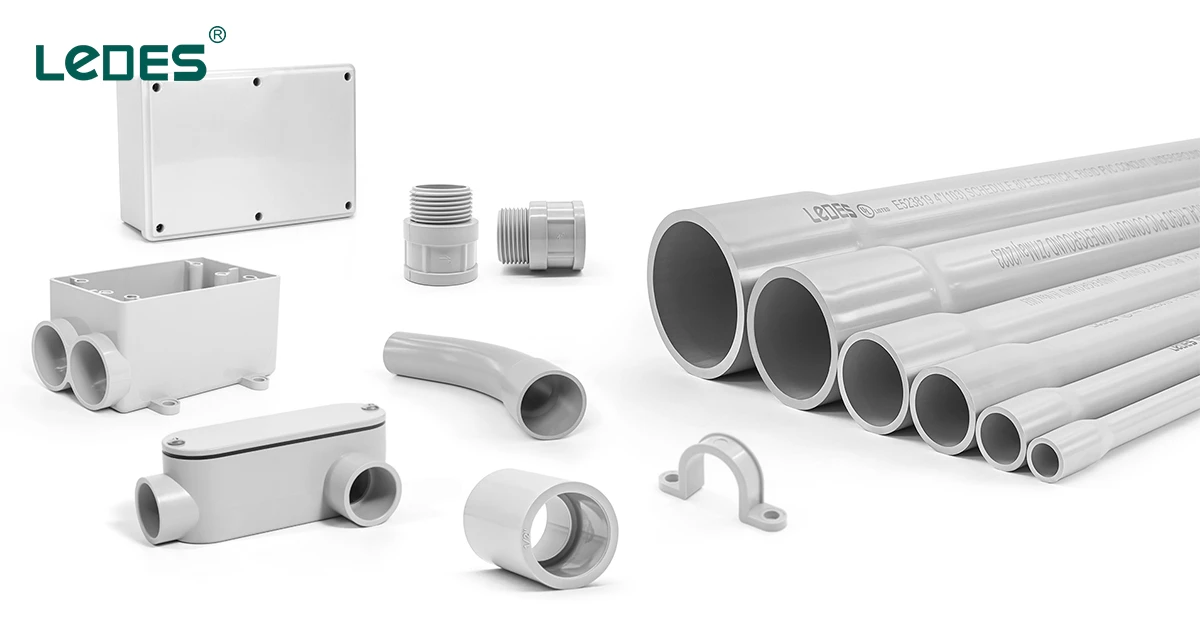
Lédes Ledes propose une gamme complète de conduits et raccords électriques en PVC conformes aux normes internationales de qualité et de certification. Que vous ayez besoin de conduits légers pour le câblage résidentiel ou de solutions renforcées pour les installations souterraines et encastrées dans le béton, Ledes vous garantit des performances constantes, des matériaux fiables et une compatibilité totale des produits pour vous accompagner de A à Z dans votre projet.
Si vous souhaitez explorer plus en détail les annexes 40 et 80, vous pouvez consulter nos guides approfondis : Conduits en PVC Schedule 40 vs Schedule 80 – Le guide ultime et Conduits en PVC de l'annexe 80 : fonction, taille et conformité au code. Ces articles fournissent des explications plus détaillées sur le comportement des matériaux, l'impact de l'épaisseur des murs, les exigences des codes et les considérations relatives à l'installation.
Pour en savoir plus sur les normes, les applications et les comparatifs de conduits électriques, n'hésitez pas à consulter l'ensemble de nos ressources sur le blog de Ledes. Vous y trouverez des guides complets conçus pour vous aider à choisir le conduit adapté à chaque projet.
9. Conclusion
Il est essentiel de comprendre les différences entre les conduits électriques en PVC de type 40, 80, A et EB pour choisir le système de protection de câblage approprié.
De la résistance mécanique et de la durabilité environnementale aux exigences d'installation et aux scénarios d'application, chaque type de conduit offre des avantages uniques qui le rendent adapté à des conditions de projet spécifiques.
Choisir le bon conduit garantit non seulement une performance et une sécurité à long terme, mais contribue également à assurer la conformité aux normes NEC, CSA et aux normes de construction locales.
Les exigences d'essai et les descriptions des normes présentées dans cet article sont fournies à titre indicatif seulement. Les critères de certification, les seuils de performance et les procédures de conformité peuvent varier selon les dernières révisions des normes UL, CSA, NEC ou autres documents réglementaires. Pour obtenir les renseignements les plus précis et à jour, veuillez toujours consulter les normes officielles, la documentation du fabricant et les publications réglementaires en vigueur. En cas de divergence ou d'interprétation obsolète dans cet article, les normes originales et les mises à jour officielles prévalent.
Merci de votre lecture. Nous espérons que cet article vous sera utile. Pour tout projet, question sur nos produits ou demande de solutions personnalisées, N'hésitez pas à nous contacter.
10. FAQ

Les normes Schedule 40 et Type A sont-elles interchangeables ?
Pas nécessairement. Bien que les deux types puissent être utilisés en intérieur, le type Schedule 40 offre une résistance mécanique supérieure, est reconnu par le NEC pour des conditions plus exigeantes et est également homologué pour une utilisation souterraine. Le type A n'est pas homologué pour l'enfouissement et est destiné uniquement à des applications intérieures légères.
Pourquoi les codes d'inhumation diffèrent-ils entre le Schedule 40, le Schedule 80 et le type EB ?
L'autorisation d'enfouissement dépend de l'épaisseur de la paroi du conduit, de sa résistance aux chocs et de sa tenue à long terme sous la pression du sol. Le type EB présente des exigences structurelles spécifiques pour les conduits souterrains, tandis que le Sch 80 offre une résistance à la compression supérieure au Sch 40, ce qui le rend adapté aux zones exposées aux risques de dommages physiques.
Quelles sont les meilleures pratiques pour le support des conduits en PVC ?
L'espacement des supports dépend du type et du diamètre du conduit. Les conduits de type Schedule 40 nécessitent généralement un espacement plus réduit que ceux de type Schedule 80. Les supports doivent empêcher l'affaissement, permettre la dilatation thermique et éviter de solliciter les joints. Les installations horizontales et verticales ont des exigences d'espacement différentes, et les conduits encastrés nécessitent un support supplémentaire lors du coulage du béton.
Quelles sont les limitations lors de l'installation de conduits dans des zones à fort trafic ou à forte charge ?
Dans les zones à fort trafic ou soumises à des charges importantes, les conduits de type Schedule 80 sont recommandés en raison de leur résistance mécanique supérieure. Les conduits de type A et EB ne conviennent pas aux zones à fort impact. Un revêtement de protection ou un enrobage en béton peut être nécessaire pour une durabilité accrue.
Que signifie la température nominale de 90 °C pour les fils électriques ?
La température de 90 °C indique la température maximale de fonctionnement continu que l'isolation d'un conducteur électrique peut supporter en toute sécurité. De nos jours, la plupart des câbles utilisés dans le bâtiment sont conçus et spécifiés pour un fonctionnement à 90 °C, notamment dans les projets commerciaux, industriels et d'infrastructures.
Pourquoi les conduits en PVC doivent-ils également être conçus pour un câblage à 90 °C ?
Lorsqu'un système de conduits est spécifié pour être utilisé avec des conducteurs de 90 °C, il est impératif que le conduit lui-même résiste aux mêmes conditions thermiques. L'utilisation d'un conduit non conforme à cette température dans de tels systèmes peut entraîner une non-conformité, une réduction de la capacité du conducteur ou un rejet lors de l'inspection.
Qui vérifie la conformité des conduits en PVC à une température de 90 °C ?
Les essais et la certification sont effectués par des organismes tiers indépendants tels que UL, ETL, CSA ou NSF. Ces organismes réalisent les évaluations dans des laboratoires accrédités et délivrent des homologations ou des certifications officielles confirmant la conformité à l'exigence de 90 °C.
À quoi sert généralement un conduit en PVC de type A ?
Les conduits en PVC de type A sont principalement conçus pour les installations électriques intérieures courantes. Ils sont fréquemment utilisés dans des environnements contrôlés où les charges mécaniques extrêmes, les contraintes d'enfouissement ou une forte résistance aux chocs ne sont pas requises. Leur paroi plus légère facilite la manipulation et l'installation.
Que signifie le type EB dans le domaine des conduits électriques en PVC ?
Le type EB signifie « enfouissement enrobé ». Il s'agit d'un conduit en PVC conçu pour les installations souterraines où le conduit est enrobé de béton ou d'un matériau de protection équivalent, au lieu d'être enterré directement dans le sol.
En quoi le conduit PVC de type EB diffère-t-il du conduit PVC de type A ?
Comparé au type A, le type EB présente des parois plus épaisses et une résistance mécanique supérieure, ce qui le rend adapté aux environnements souterrains enrobés de béton. Le type A est généralement utilisé pour des applications hors sol ou moins exigeantes et n'offre pas le même niveau de protection sous charges structurelles.